What You Need to Know
- Most lower back pain is nonspecific low back pain, which means no single damaged structure explains it. About 90 percent of cases fall in this bucket, per the World Health Organization.
- Rest is not the fix. Gentle movement in the first 48 hours, then progressive loading, is what the evidence supports.
- Start with the McGill Big 3: modified curl-up, side plank, bird dog. Short holds, no spinal flexion under load.
- Add walking. A 2024 Lancet trial found a progressive walking and education program roughly doubled the pain-free stretch between episodes.
- Stretching feels good but does not build tolerance. Strength does. Glute bridge, hip hinge, and loaded carries are the next rung.
- Red flags (numbness, leg weakness, loss of bladder control, pain after trauma) mean stop and see a doctor, not a trainer.
The short answer: the best lower back pain exercises combine daily walking, three spine-stability drills (curl-up, side plank, bird dog), and a slow return to hip-driven strength work like the glute bridge and hip hinge. Most people need eight to twelve weeks of consistency, not eight to twelve days.
Why does your lower back hurt, and what actually fixes it?
Most lower back pain has no clear structural cause on a scan. The World Health Organization classifies roughly 90 percent of cases as nonspecific low back pain, meaning serious disease has been ruled out and no one disc or joint can be blamed.
That sounds like bad news. It is the opposite.
Think of your back like a bank account. Sleep, walking, and steady training make deposits. Long meetings, a bad night, a heavy moving day, and stress all make withdrawals. Pain shows up when the account goes negative, not because something snapped.
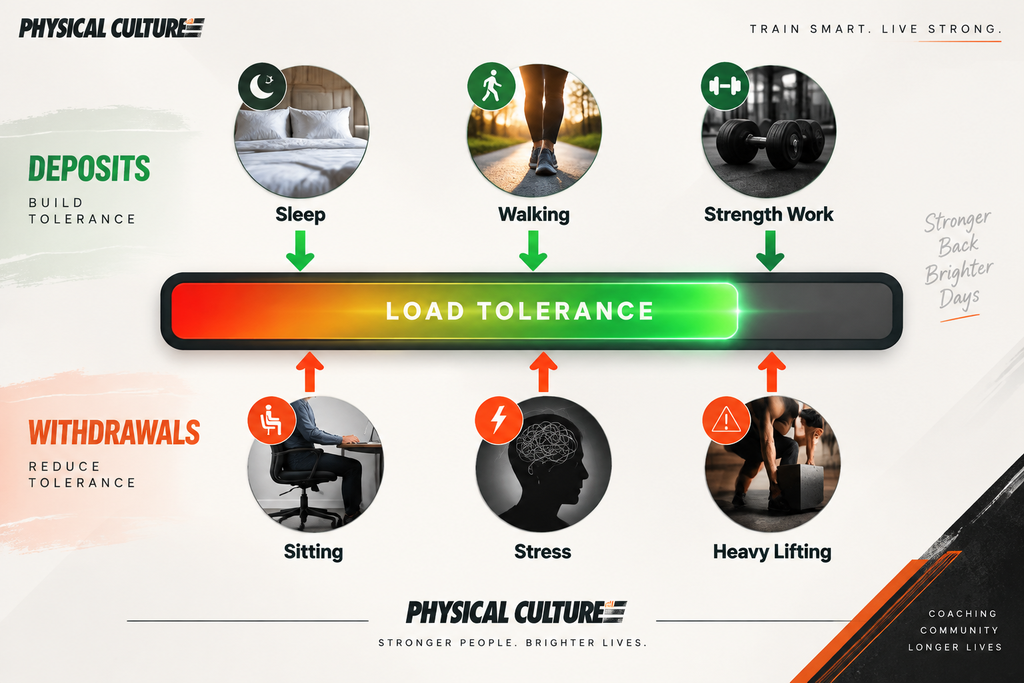
This is what pain science has spent two decades establishing: pain is a protective output, not a damage readout. Herniated disc findings show up on MRIs of people with zero symptoms all the time. Sciatica, the radiating leg pain that comes from an irritated nerve root, is the one pattern that does point somewhere specific.
We see this every week in Gowanus. Someone arrives convinced their spine is fragile, and four weeks of graded loading later they are hip hinging with a barbell.
Here is our position, flatly: for the average desk-bound adult, the lower back is not weak because it is injured. It is sensitive because it has been under-loaded and over-sat for years.
How to relieve lower back pain in the first 48 hours
Relieve lower back pain early by moving little and often rather than lying still. Bed rest stiffens the area and slows recovery.
Three things to do on day one:
- Change position every 30 minutes. Prolonged sitting is the single biggest aggravator we hear about from clients who commute and desk-work all day.
- Walk five to ten minutes, several times. Flat ground, easy pace, arms swinging.
- Run gentle mobility, not aggressive stretching. Cat-cow, supine knee rocks, and a supported hip hinge against a counter.
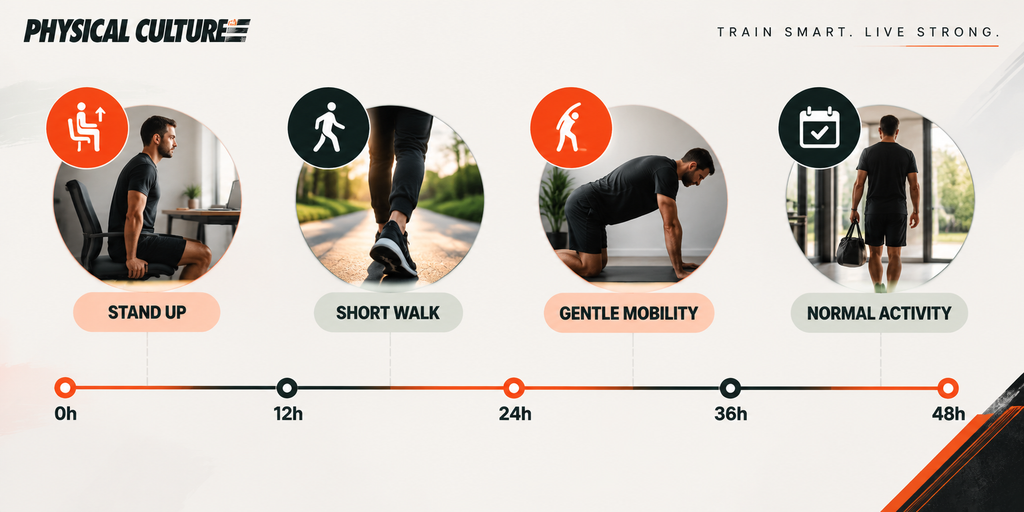
What to skip: hard end-range stretching, sit-ups, and “cracking it out” with twisting. A tight back is usually a guarding back, and yanking on a guarded muscle tends to raise the alarm rather than lower it.
One honest caveat. If your pain is severe, unrelenting at night, or came from a fall or a crash, none of this applies. Get assessed first.
Is walking good for back pain? The evidence says yes
Walking is good for back pain, and it is the most underrated intervention on this page.
The WalkBack trial, published in The Lancet in June 2024, randomized 701 adults who had recently recovered from an episode of nonspecific low back pain. One group got an individualized, progressive walking program plus education from physiotherapists over six months. The other got nothing.
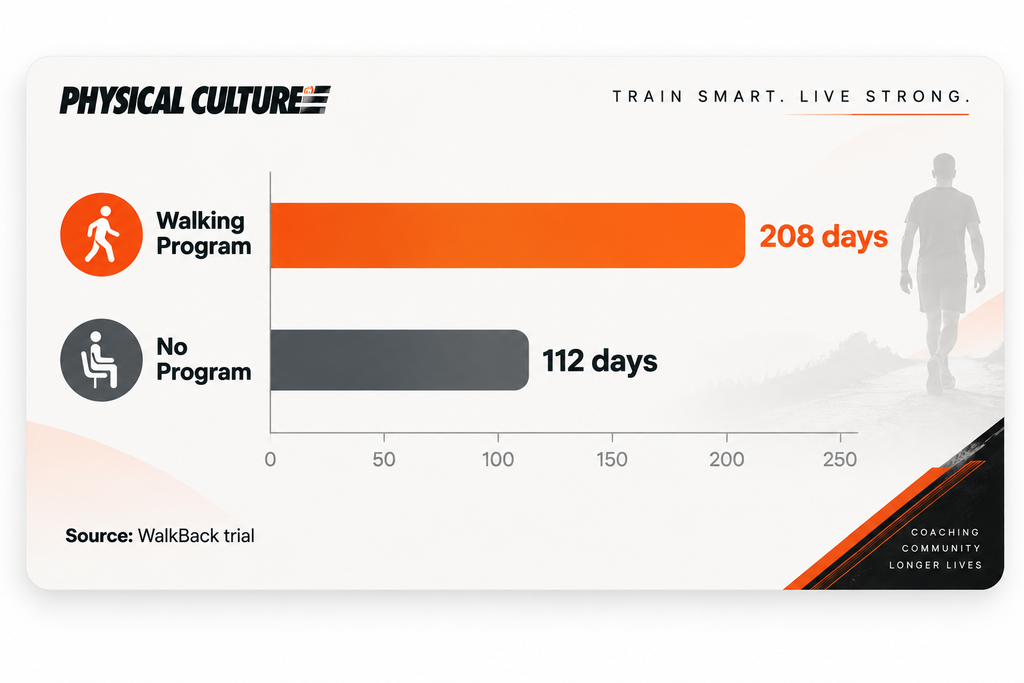
The walking group went substantially longer before their next flare. Recurrence is the real problem with back pain: roughly 70 percent of people relapse within twelve months of recovering, which is why prevention matters more than any single stretch.
Practically, that means aiming for 20 to 30 minutes of continuous walking most days, built up gradually. Prospect Park loops count. So does walking the long way to the F train.
Walking works because it loads the lumbar spine rhythmically and at low intensity, which feeds the tissue without spiking symptoms. It also restores confidence in movement, which matters more than most people expect.
Which core exercises for back pain are worth your time?
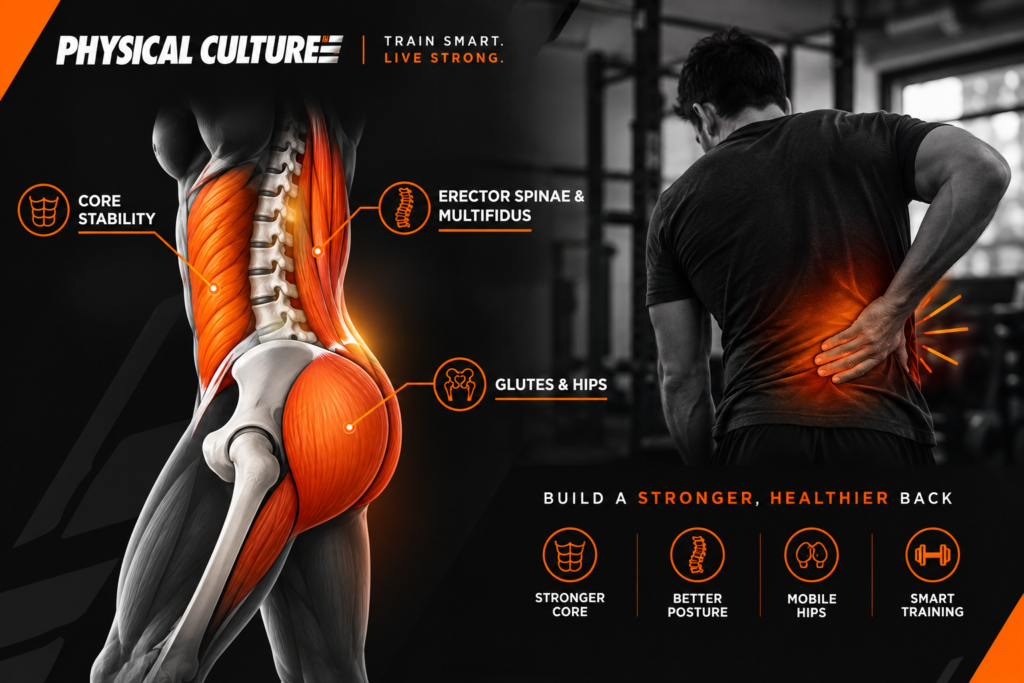
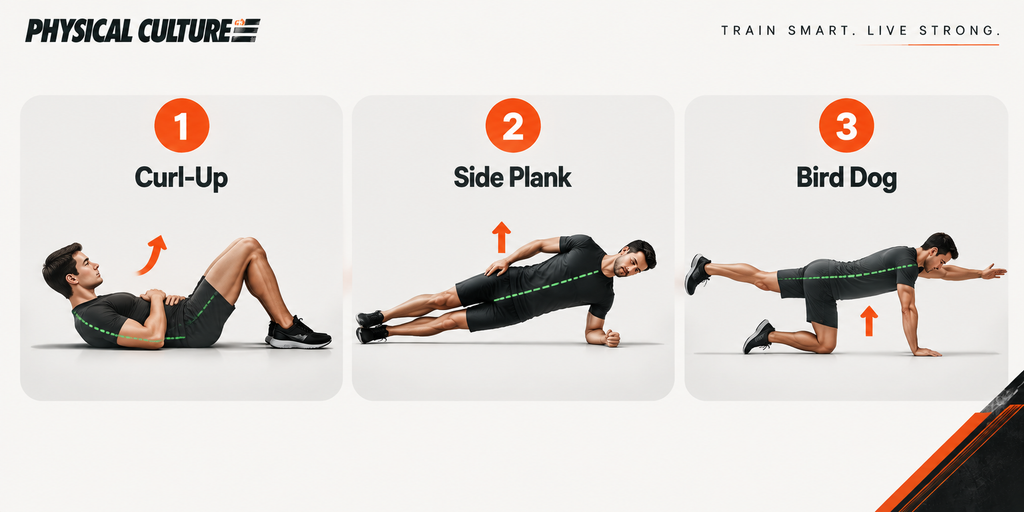
The McGill Big 3 are the core exercises for back pain with the best track record: the modified curl-up, the side plank, and the bird dog. Professor Stuart McGill built them from spine biomechanics research, and the logic is simple. Your core’s job is to resist movement, not create it.
Picture a tent pole. The pole does not hold itself up. The guy-lines around it do, and they work by staying taut, not by yanking. Your multifidus, erector spinae, and abdominal wall are those guy-lines.
Run all three as short holds, 8 to 10 seconds, breathing normally, using a 5-3-1 pyramid (five reps, rest, three reps, rest, one rep) per side.
1. Modified curl-up. Lie on your back, one knee bent, hands under your lower back to preserve the natural arch. Lift your head and shoulder blades a fraction off the floor. Your lumbar spine should not move at all.
2. Side plank. On your elbow, knees bent to start. Lift your hips until your body makes one line. Progress to straight legs only when the knee version is easy and painless.
3. Bird dog. On all fours, brace lightly, extend one arm and the opposite leg. The bird dog exercise fails when the hips rotate or the low back sags, so imagine balancing a full mug on your lower back.
Add the dead bug as a fourth if you want a supine option: lie on your back, arms up, knees at 90 degrees, and lower one arm and the opposite leg while keeping your ribs down.
A caveat we give every client: the curl-up turns into a crunch the moment you chase your head off the floor. Done that way it can flare you. Quality beats reps here, every time.
Training with a coach beats guessing at form. Our coaches run a movement screen before anything else, and if you want an eye on your bird dog position this week, book a discovery call with Physical Culture.
What lower back strengthening exercises come after the Big 3?
Lower back strengthening exercises should move from stability to hip-driven strength once you can hold the Big 3 without symptoms for about two weeks.
The best exercises for lower back pain at this stage are hip-dominant, not spine-dominant. Stability teaches the spine to stay still. Strength teaches the hips to do the work the spine keeps volunteering for. That handoff is the whole game.
- Glute bridge. Feet flat, drive through the heels, squeeze at the top, no arching. This is the gateway to hip extension strength.
- Hip hinge, unloaded. Dowel along the spine touching head, mid-back and tailbone. Push the hips back, keep all three contact points.
- Suitcase carry. Walk 20 metres with a weight in one hand. It trains lateral core stability under real load, which the side plank only approximates.
- Bent-over row and pull-down variations. These load the erector spinae isometrically while you build back strength.
- Split squat. Single-leg work exposes and fixes the hip imbalances that keep feeding back symptoms.
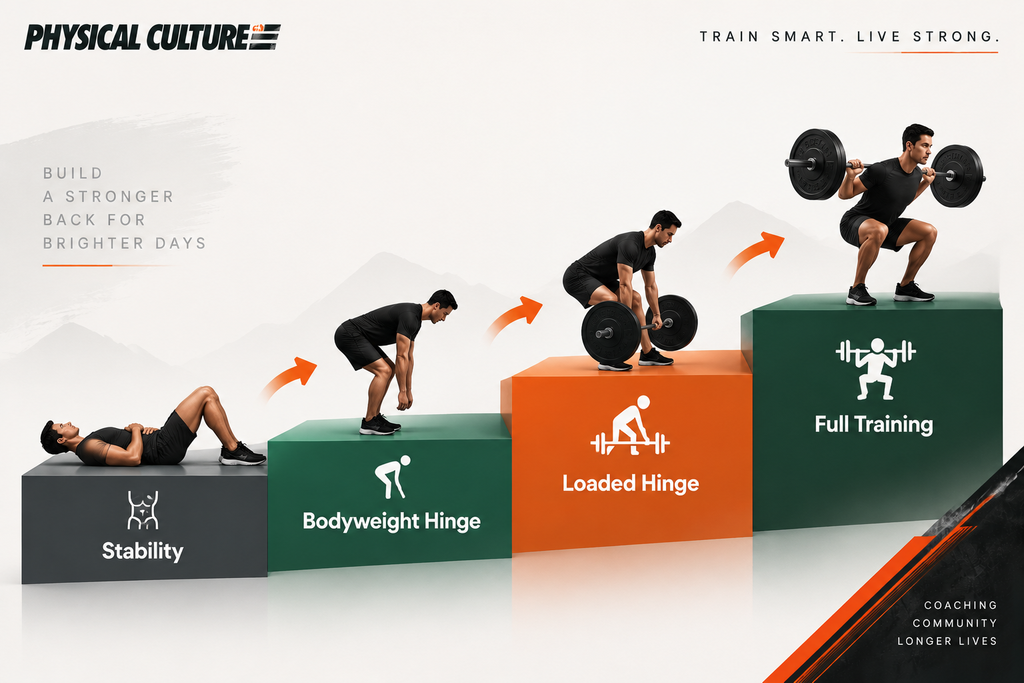
Progress by adding one variable at a time: reps, then load, then range. Never all three in one week.
Mobility work still belongs here, just as a side dish rather than the main course. Hip flexor and hamstring length affect how your pelvis sits, and pelvic position affects lumbar posture. Posture matters less as a fixed ideal and more as variety, so the best posture is usually your next one.Do stretches for lower back pain actually help?
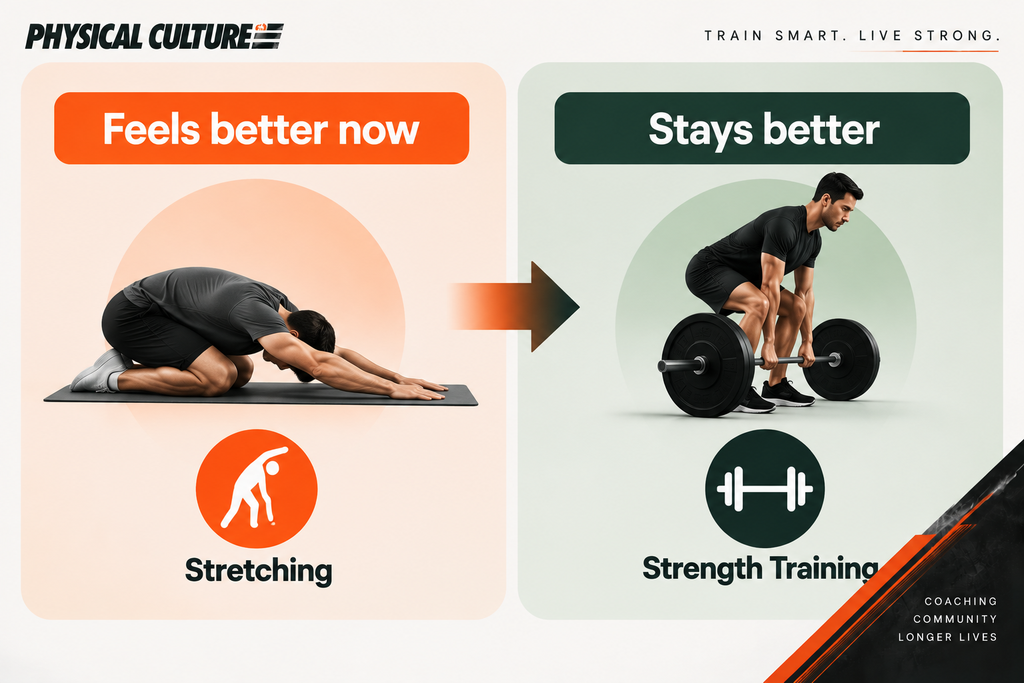
Stretches for lower back pain relieve symptoms temporarily, but they rarely change why the pain keeps coming back.
Stretching is aspirin. Strength training is the dentist. One buys you a comfortable afternoon, the other fixes the cause.
That said, the relief is real and worth having. These four are the ones our coaches use most:
- Figure four, for the glutes and deep hip rotators
- Supine hamstring stretch with a strap, for the posterior chain
- Cat-cow, for gentle lumbar mobility rather than length
- Half-kneeling hip flexor stretch, for people who sit eight hours a day
Hold 20 to 30 seconds. Stop if anything travels down your leg.
One exception worth knowing: with a suspected herniated disc, physical therapists often steer people away from deep forward flexion like toe touches, and toward neutral or extension-based positions instead. With spinal stenosis, the guidance flips. That is a good reason to get a real physical therapy assessment rather than copying a stretching video.
Can you deadlift with back pain?
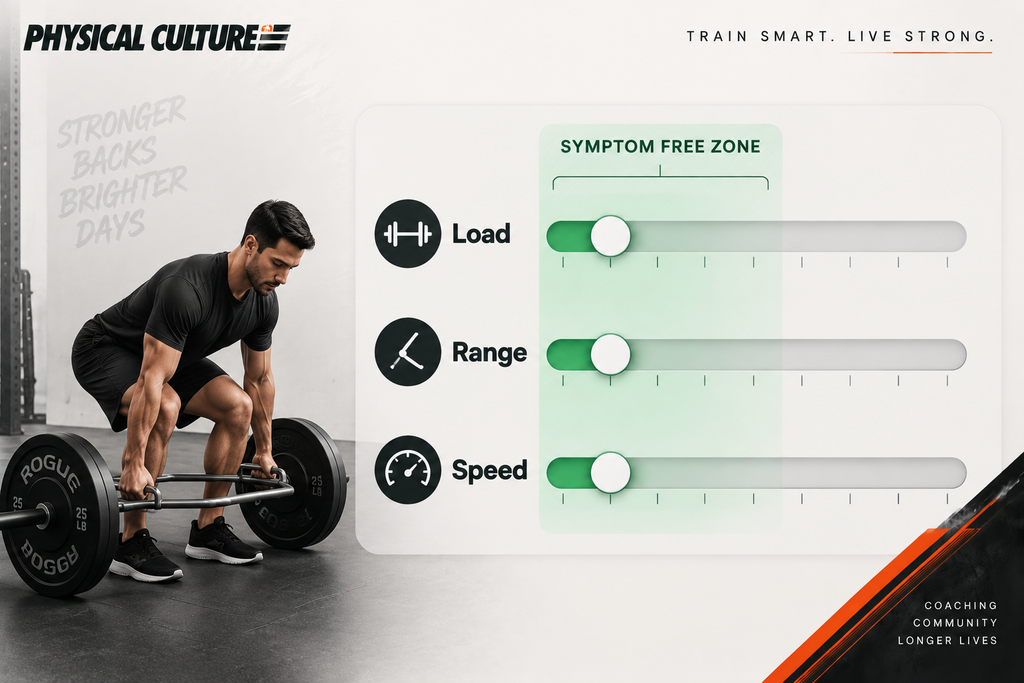
Deadlifting with back pain is often possible, using graded exposure: reduce the load and range until the movement is symptom-free, then rebuild.
Graded exposure is not a slower version of the same lift. A trap bar deadlift from blocks at 40 percent of your usual weight is a different exercise to a max-effort pull from the floor, even though both are called a deadlift. The skill is knowing which dial to turn.
We keep this short here because we wrote a full breakdown of auto-regulation, symptom rules and training modifications in our guide to training with lower back pain while you keep lifting. Start there if you are an active lifter rather than a desk worker.
The principle underneath it comes straight from pain science: avoidance teaches the nervous system that a movement is dangerous. Controlled exposure teaches it the opposite.
What does a realistic weekly routine look like?
| Day | Core work | Strength | Walking |
| Monday | McGill Big 3, 5-3-1 | Glute bridge, hip hinge | 20 min |
| Tuesday | Dead bug, 2 sets | Rest | 30 min |
| Wednesday | McGill Big 3, 5-3-1 | Split squat, row | 20 min |
| Thursday | Mobility only | Rest | 30 min |
| Friday | McGill Big 3, 5-3-1 | Suitcase carry, hinge | 20 min |
| Weekend | Optional Big 3 | Anything you enjoy | 30 min+ |
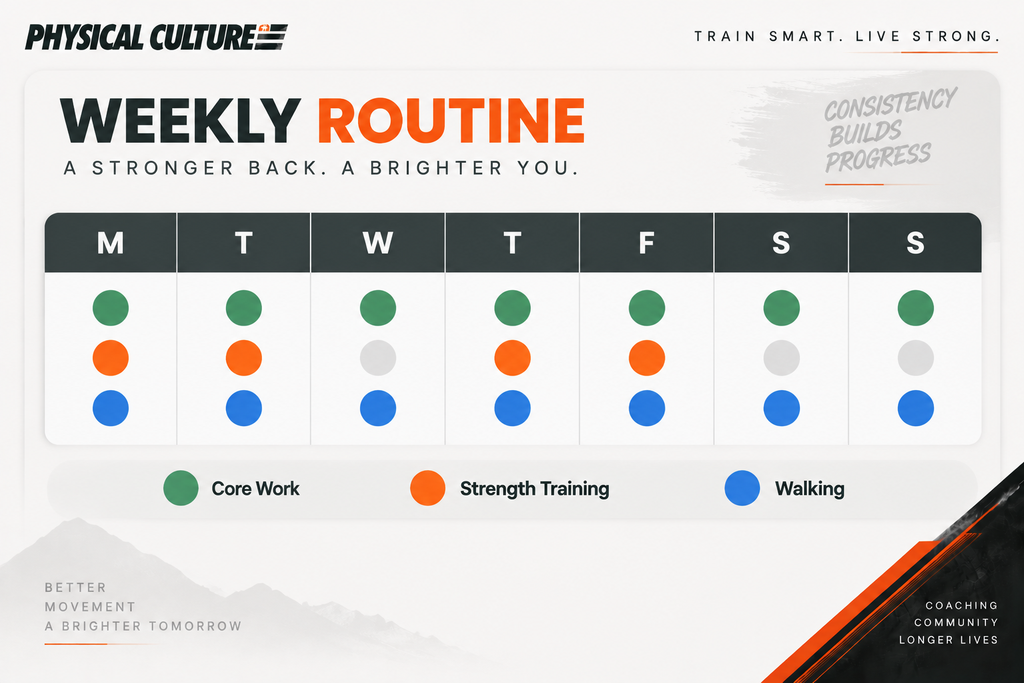
Total commitment: about 15 minutes of floor work plus a walk. That is it.
Expect the first noticeable change somewhere between week three and week six, not week one. Consistency beats intensity by a distance here.
When should you stop exercising and see a professional?
Stop and seek medical care if you have numbness or tingling in the legs, leg weakness, loss of bladder or bowel control, unexplained weight loss, fever, or pain that started after a fall or a car accident.
Also worth a professional opinion: pain lasting more than six weeks without improvement, or sciatica symptoms radiating below the knee.
Physical therapy diagnoses and treats. A qualified coach builds capacity around what the therapist finds.
The two jobs are different. The best outcomes we see happen when they talk to each other. Our injury rehab specialist in Brooklyn regularly coordinates programming directly with a client’s PT.
For anyone training through pregnancy or postpartum, back symptoms interact with pelvic floor and core recovery, which is its own specialty. That work sits with our women’s health coaching team.
This article is educational and is not medical advice. We are strength coaches, not physicians or physical therapists. See a licensed clinician for diagnosis.
Frequently asked questions
What is the fastest way to relieve lower back pain at home?
Gentle movement repeated through the day beats anything held once. Walk five minutes, run through cat-cow and supine knee rocks, and change position every half hour. Heat helps stiffness. Most acute episodes settle substantially within two to six weeks. If pain is worsening rather than plateauing, that is your signal to get assessed rather than push harder.
Is it better to rest or exercise with lower back pain?
Exercise, in almost every case. Extended bed rest is no longer recommended by major guidelines because immobility increases stiffness and fear of movement. The nuance is intensity: reduce load and range, keep frequency high. Think ten easy things a day, not one hard session. Sharp, radiating or worsening pain is the exception and needs assessment.
How long does it take for back exercises to work?
Give it three to six weeks for meaningful change and eight to twelve for durable change. Stability work like the bird dog can reduce symptoms within days, but building genuine load tolerance in the hips and back takes a training block. People who quit at week two almost always quit right before the useful part.
Are sit-ups bad for your lower back?
Traditional sit-ups repeatedly flex the lumbar spine under load, which is exactly the pattern most sensitive backs tolerate the worst. The modified curl-up exists because it trains the same muscles while keeping the spine neutral. If you love ab work, swap sit-ups for dead bugs, planks and carries. You lose nothing and stop poking the bear.
Can core exercises make back pain worse?
Yes, if the dose or the form is wrong. The most common culprits are curl-ups performed as crunches, side planks held past fatigue, and bird dogs with a sagging spine. Short holds and clean positions matter more than volume. If an exercise increases symptoms during or after, regress it rather than abandoning core work entirely.
Is walking or stretching better for lower back pain?
Walking, if you only pick one. Stretching gives short-term relief without changing tolerance, while walking loads the lumbar spine gently and repeatedly, which is what builds capacity. The Lancet WalkBack trial found a progressive walking program meaningfully delayed recurrence. Use stretching as symptom relief around a walking and strength habit, not instead of it.
What is the McGill Big 3 and who is it for?
The McGill Big 3 is a set of three spine-stability exercises: the modified curl-up, the side plank and the bird dog. They suit almost anyone with nonspecific low back pain because they build endurance in the muscles surrounding the lumbar spine without loading it into flexion. They are a starting point, not a complete program.
The bottom line
Walk daily. Run the McGill Big 3 three times a week. Move from stability to hip strength once symptoms settle.
Treat stretching as relief rather than treatment. Escalate to a clinician if red flags appear.
Back pain is the leading cause of disability worldwide, affecting 619 million people according to the World Health Organization, and most of those people were told to rest. Better advice exists now.
If you are in Brooklyn and want this built around your actual schedule, our coaches do that daily at 55 Ninth Street in Gowanus.
Start with a free 30 minute discovery call. If you already train and just want eyes on your form, see how our coached open gym in Brooklyn works.
Physical Culture Brooklyn, 55 Ninth Street, Brooklyn, NY. Call 917-946-3000.