30-Second TL;DR
• ACOG recommends at least 150 minutes of moderate activity per week during an uncomplicated pregnancy. Exercise does not raise the risk of miscarriage, low birth weight or early delivery.
• Ignore heart rate caps. The talk test and rate of perceived exertion replaced the old 140 bpm rule years ago.
• The 25 pound lifting limit you may have read is not an ACOG guideline. Strength training is encouraged, adjusted to how you feel.
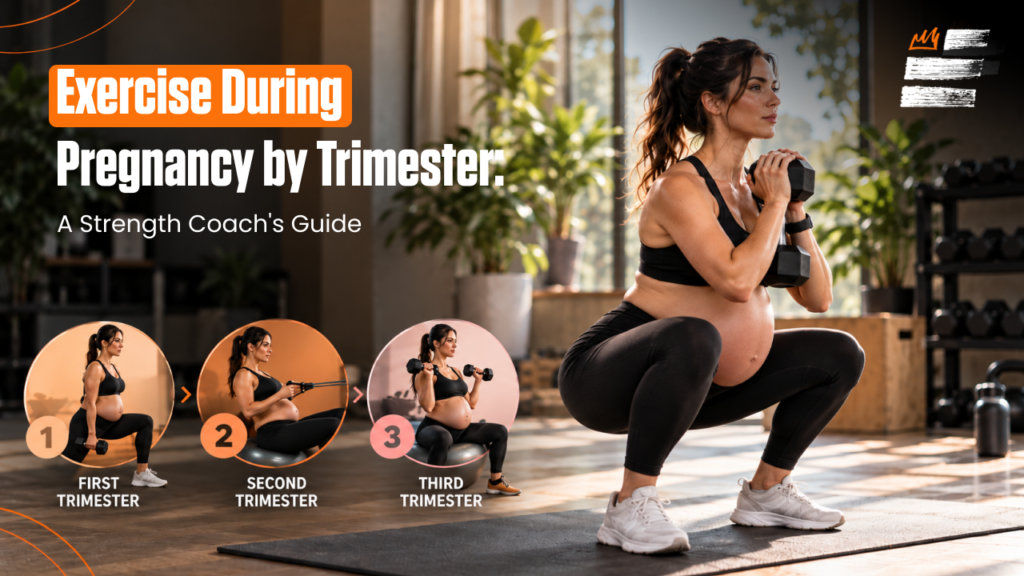
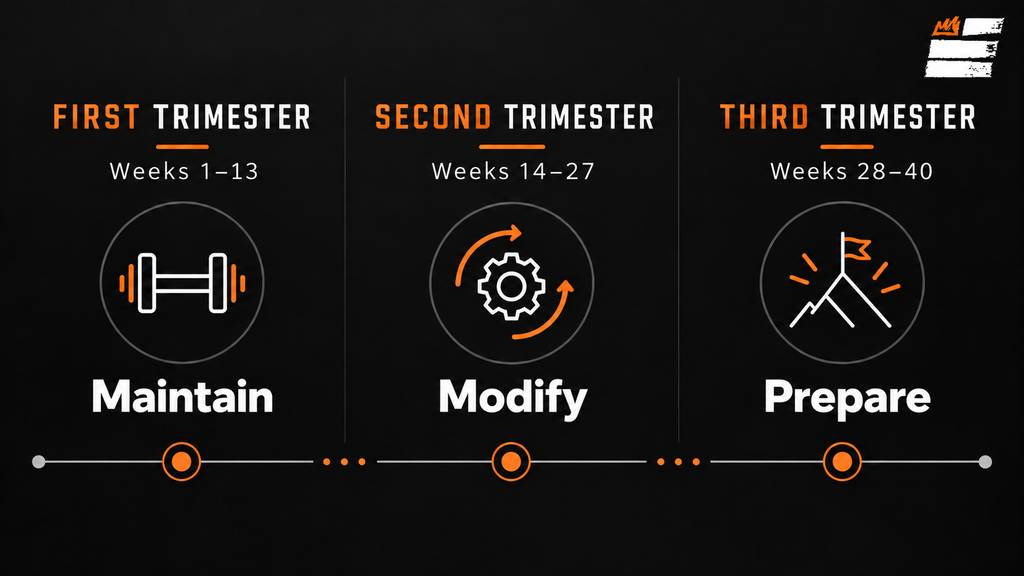
• The first trimester usually needs the fewest changes. The second trimester brings balance and supine exercise decisions. The third trimester is about position, breath and preparing for labor and delivery.
• Train your pelvic floor and breathing mechanics from week one, not after the baby arrives.
• Bleeding, fluid leakage, chest pain, calf swelling, regular painful contractions or dizziness mean stop and call your OBGYN.
The short answer: exercise during pregnancy works best as continuous strength and walking practice, adjusted each trimester for position, balance and pressure rather than stopped. Most cleared, uncomplicated pregnancies can train two to four days a week right through the third trimester.
Is exercise during pregnancy actually safe?
Exercise during pregnancy is safe and recommended for most people with uncomplicated pregnancies, and it is used as part of treatment for gestational diabetes rather than being restricted by it. The American College of Obstetricians and Gynecologists, ACOG, states that physical activity does not increase the risk of miscarriage, low birth weight or early delivery.
Prenatal exercise has a clear weekly target: at least 150 minutes of moderate intensity aerobic activity, which you can split into 30 minutes on five days or into shorter blocks across each day.
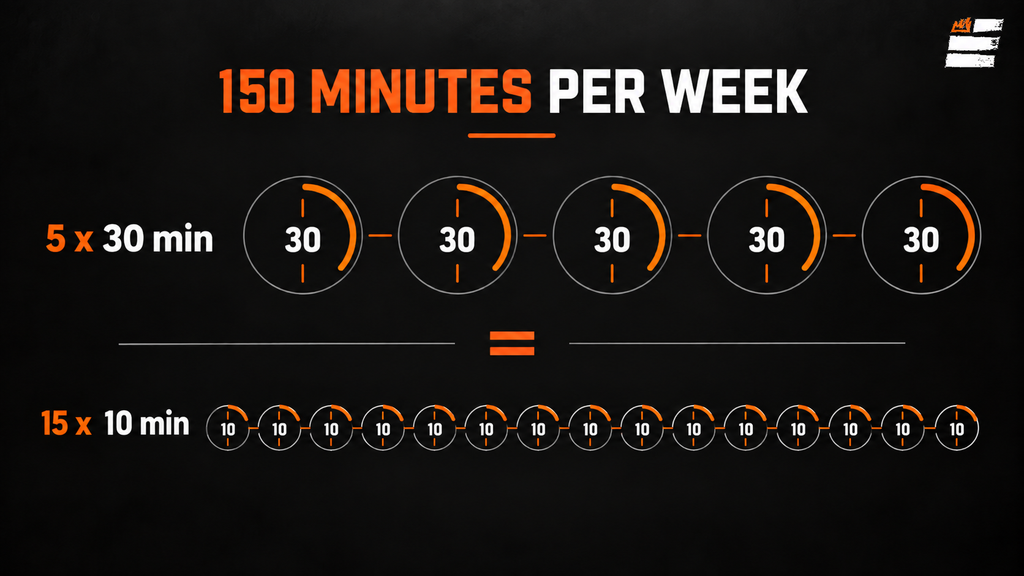
ACOG also notes that exercising during pregnancy is associated with lower rates of gestational diabetes, cesarean birth and operative vaginal delivery, plus faster postpartum recovery.
Think of pregnancy like a nine month endurance event you did not get to taper for. Nobody arrives at the start line of a marathon by resting for nine months. Capacity built now is capacity you carry into delivery and the fourth trimester.
Here is our position, stated plainly: the default should be to continue training with modifications, not stop and wait. The people who struggle most postpartum are usually the ones who stopped moving entirely at week eight.
Who this does not apply to. Certain conditions make exercise unsafe or require a modified plan: significant heart or lung disease, cervical insufficiency, placenta previa after 26 weeks, preeclampsia or pregnancy induced hypertension, ruptured membranes, and preterm labor in this pregnancy. That list is not exhaustive, which is exactly why clearance comes first.
How hard should you work? Forget heart rate, use the talk test
Intensity during pregnancy is measured by rate of perceived exertion and the talk test, not by a heart rate ceiling.
The old advice capped pregnant exercisers at 140 beats per minute. ACOG removed that number decades ago, because heart rate responds differently in pregnancy and the same figure means wildly different efforts in different people.
Some sources still print a cap. One hospital page currently ranking for this topic tells new exercisers to stay below 150 bpm, then three paragraphs later correctly says moderate activity has no heart rate limitation.
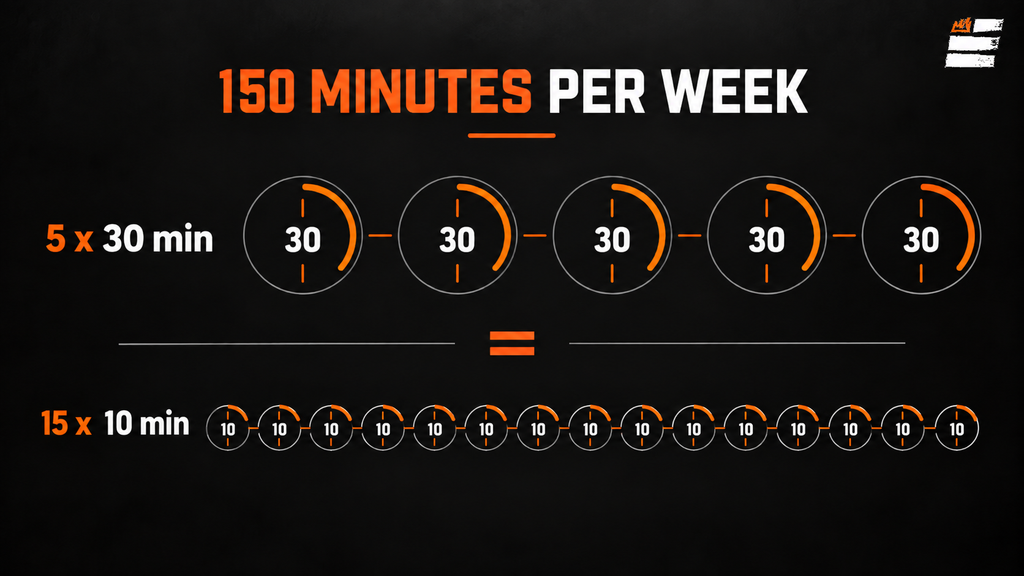
Use these two instead:
• The talk test. You should be able to hold a conversation. Able to sing, go harder. Unable to finish a sentence, ease off.
• Rate of perceived exertion. On a 1 to 10 scale, live at 5 to 6 for most work. Occasional 7 is fine if you were training at that level before.
RPE is the honest measure because it adjusts itself. On a bad sleep week, the same weight feels like an 8, and the scale tells you to back off without you having to decide anything.
First trimester workouts: change less than you think
First trimester workouts usually need the fewest modifications. If you were training before pregnancy and have been cleared, most of your program can continue roughly as written.
Pregnancy workouts in this stage look a lot like your old ones. What changes first is not your body, it is your energy. Nausea and fatigue peak in weeks six to twelve for many people, and that is the real programming constraint.
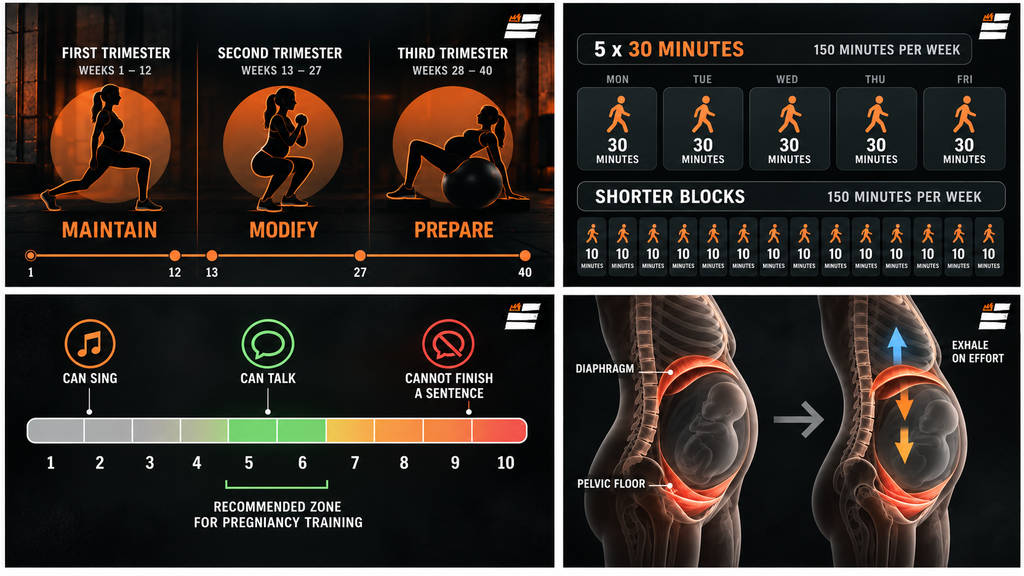
Practical adjustments for prenatal fitness in the first trimester:
• Cut volume before you cut load. Three sets become two. The lift stays.
• Avoid overheating. Thermoregulation matters most early. Cool room, extra water, no hot yoga, no saunas.
• Start pelvic floor and breathing work now. This is the single most underused window.
• Keep walking. Even ten minute blocks count toward the 150.
On breathing mechanics: the goal is exhaling on effort rather than bracing and holding. Holding your breath under load spikes intra abdominal pressure, which is the pressure your pelvic floor has to absorb. Blow out as you press, push or stand up.
Second trimester: the modifications that actually matter
The second trimester is when real adjustments begin, driven by three changes: a shifting centre of gravity, rising ligament laxity, and the question of lying on your back.
Relaxin, the hormone that softens ligaments to prepare the pelvis for birth, is often blamed for everything. It does increase joint laxity, which is why end range stretching and unstable single leg work get riskier. It does not make you fragile. Load is still fine; wobbling is what to avoid.
On supine exercise. Guidance genuinely conflicts here. Some sources rule out all back lying after week 12 or 20 because the growing uterus can compress the vena cava and reduce blood flow. Others say the concern applies to prolonged stillness rather than a 30 second set.
Our practical rule: symptoms decide. If lying flat makes you dizzy, breathless or nauseated, stop and change position. Otherwise keep back lying sets short, and prop the torso on an incline once the belly is large. When in doubt, ask your OBGYN, since they know your specific pregnancy.
Second trimester swaps we use most:
• Incline everything. Bench press becomes incline press, floor work moves to a bench or wedge.
• Widen the stance. Squats and deadlifts open up to make room. Sumo stance is your friend.
• Drop the crunching. Traditional flexion work gives way to anti-rotation and carries, which manage diastasis recti risk better.
• Reduce balance demand. Split squats gain a handrail or a TRX. Not because you are weak, because your centre of gravity moved.
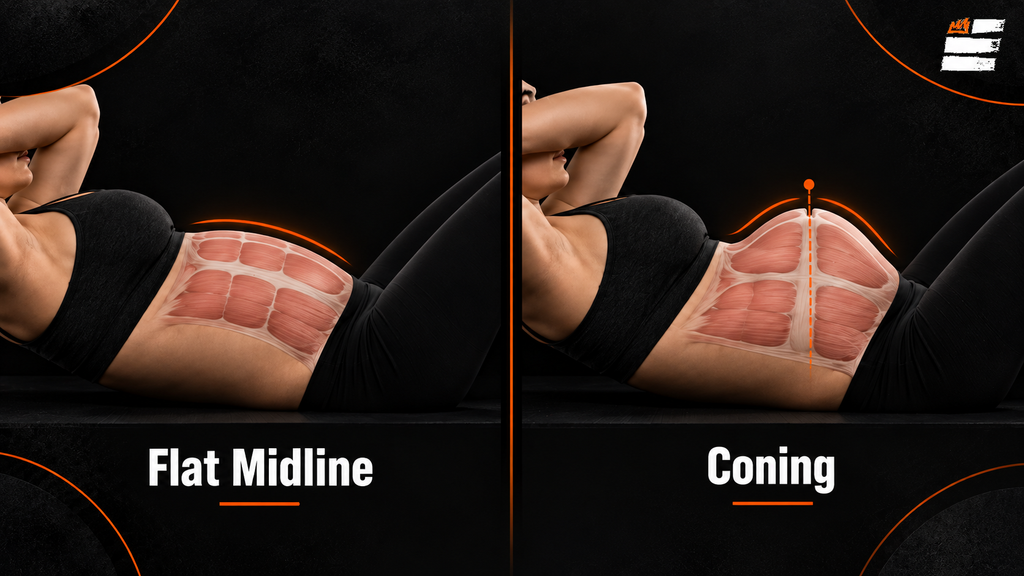
Diastasis recti, the natural separation of the abdominal wall along the midline, happens in the majority of pregnancies. It is not an injury. Watch for coning or doming along the midline during effort, and regress the exercise when it appears.
Third trimester exercise: train for labor and delivery
Third trimester exercise is less about building and more about maintaining, moving comfortably and preparing for labor and delivery.
Expect strength numbers to fall. That is normal and it is not regression, it is a body running a full time metabolic project alongside your training.
What we prioritise in the last twelve weeks:
• Hip mobility and loaded squats to a box. Deep positions rehearse birth positions.
• Carries and step-ups. Everything you will do with a car seat, only on purpose.
• Pelvic floor coordination, both directions. Contracting matters. So does relaxing, which is the half nobody trains and the half delivery requires.
• Walking, daily. The most reliable thing on this page.
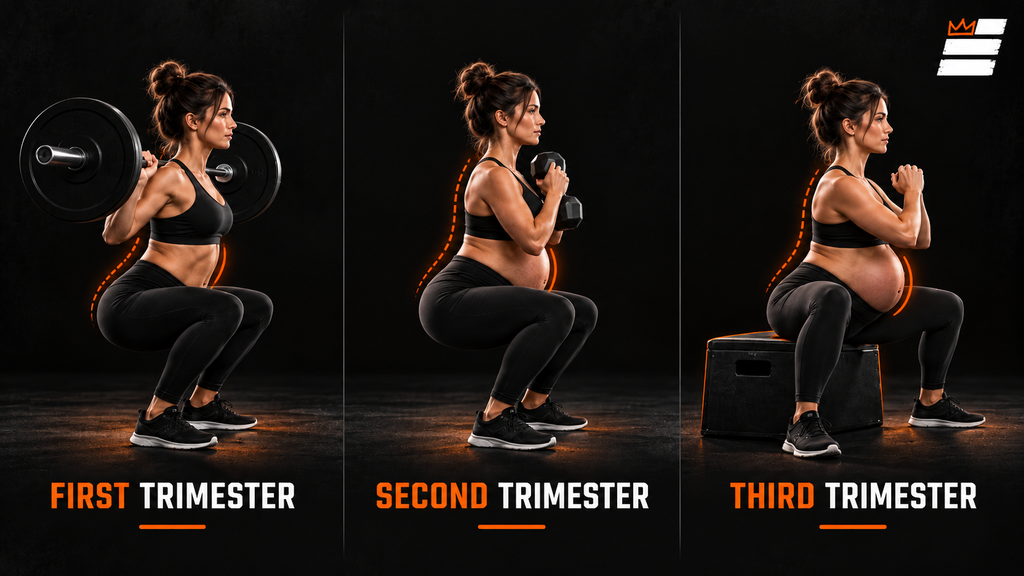
On squats during pregnancy: they stay in, almost always. Widen the stance, reduce depth if there is pelvic pressure, and swap the barbell for a goblet or a landmine as the belly grows. The pattern is the point, not the implementation.
Stop a session if you get pelvic heaviness, a dragging sensation, or leaking. Those are pressure management signals, and they mean regress the exercise, not quit training.
Can you lift weights while pregnant?
Yes. Lifting weights while pregnant is supported by ACOG, which encourages both aerobic and strength conditioning before, during and after pregnancy.
The 25 pound ceiling that circulates online, including on a hospital blog currently ranking for this topic, is not an ACOG guideline. If you were deadlifting 155 pounds in January, a 25 pound cap in May is a bigger change to your body than continuing sensibly.
How load actually gets managed across a pregnancy:
1. Keep the movements, change the numbers. Reps move toward 8 to 12, RPE sits at 5 to 6, and you leave 3 or more reps in reserve.
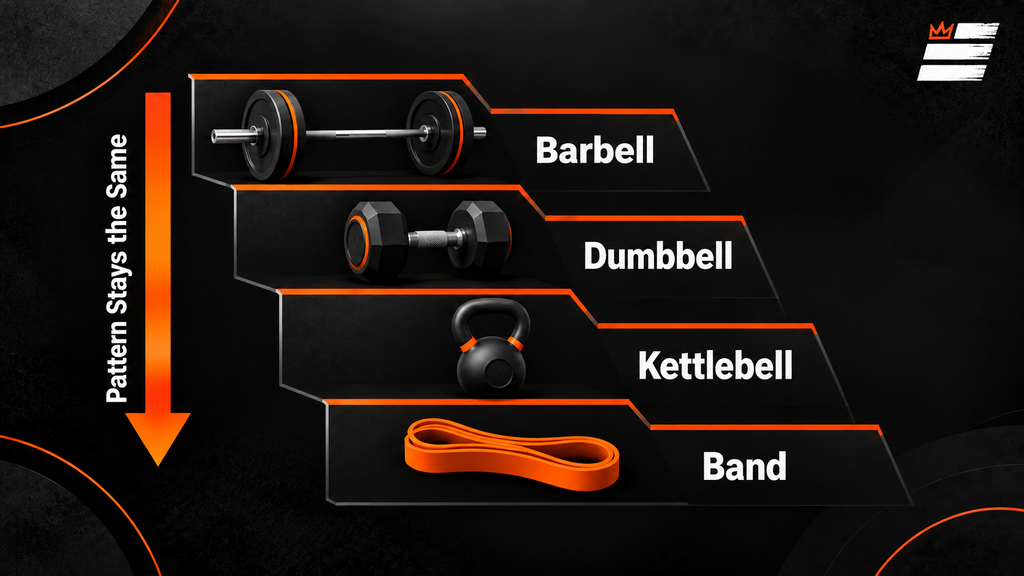
2. Regress the implement, not the pattern. Barbell to dumbbell to kettlebell to band, in that order, as the belly dictates.
3. Exhale on effort, every rep. See the breathing mechanics section above.
4. Drop anything that cones, leaks or pinches. Symptoms, not calendar, decide.
Prenatal yoga vs strength training is not a real competition. Both belong in a prenatal fitness plan. Yoga gives you breath practice, hip mobility and a calmer nervous system. Strength training gives you the capacity to carry a car seat up a brownstone stoop for seven months. Doing both is the honest answer, and if you have to pick one, pick whichever you will actually do twice a week.
Want the modifications built around your actual program? Coach Chantel programs for pregnancy week by week at our Gowanus gym. Take the free 5 minute fitness evaluation to start, or read more about women’s health coaching in Brooklyn.
Which exercises should you avoid while pregnant?
The exercises to avoid while pregnant fall into three groups: fall risk, impact or trauma risk, and pressure or heat risk.
| Avoid | Why | Do instead |
| Contact sports, skiing, horse riding | Abdominal trauma and fall risk | Stationary cycling, swimming, walking |
| Scuba diving | Decompression risk to the fetus | Water aerobics, swimming |
| Hot yoga, saunas, hot humid outdoor work | Overheating, worst in the first trimester | Same practice in a cool room |
| Breath holding under heavy load | Spikes intra abdominal pressure | Exhale on effort, reduce load |
| Prolonged flat back lying, later pregnancy | Possible vena cava compression | Incline the torso, keep sets short |
| Heavy end range stretching | Relaxin already increased laxity | Controlled range, add strength instead |
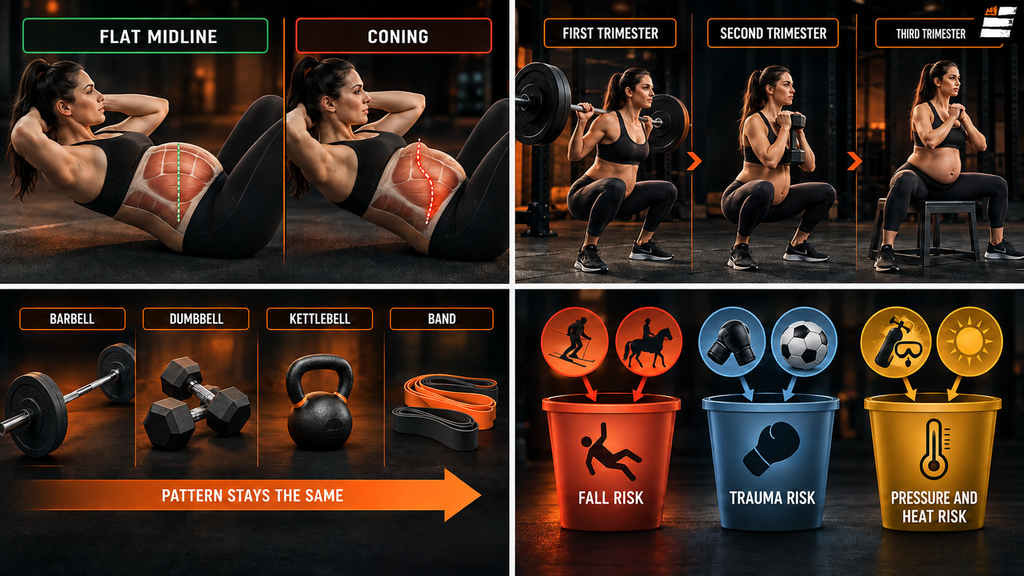
The safe exercises during pregnancy list is longer than the avoid list, and most of it is unglamorous. Notice what is not on the table above: squats, deadlifts, carries, pressing, rowing, lunging. The pattern almost never gets banned. The dose, the range and the position change.
What does a weekly plan look like in each trimester?
| First trimester | Second trimester | Third trimester | |
| Strength days | 3, near normal | 3, modified positions | 2 to 3, lighter |
| Rep range | 6 to 12 | 8 to 12 | 10 to 15 |
| Target RPE | 6 to 7 | 5 to 6 | 5 |
| Cardio | 150 min, as before | 150 min, lower impact | Walking and swimming |
| Core focus | Breathing, pelvic floor | Anti-rotation, carries | Pelvic floor release |
| Watch for | Overheating, fatigue | Coning, balance | Pressure, leaking |
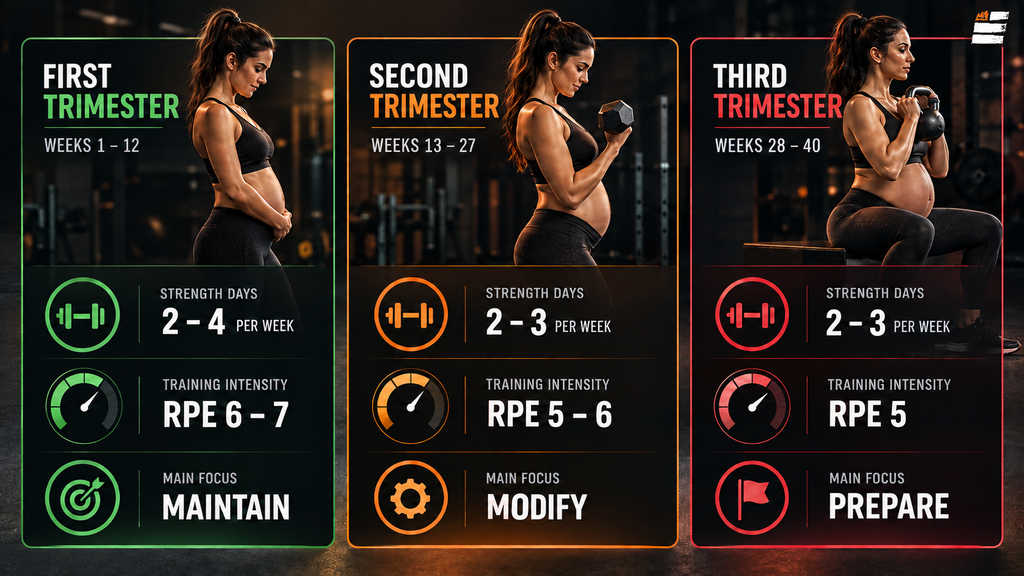
Two rules run across all three columns. Leave reps in reserve rather than training to failure. Stop any exercise that causes coning, leaking or pelvic heaviness, and regress it rather than dropping the pattern.
When should you stop exercising and call your OBGYN?
Stop immediately and contact your OBGYN or midwife if you have vaginal bleeding, fluid leaking, regular painful contractions, chest pain, shortness of breath before exertion, dizziness, headache, muscle weakness affecting balance, or calf pain and swelling.
A headache with visual changes or sudden swelling deserves a same-day call, because those can signal preeclampsia. Also worth a call, though less urgent: new pelvic heaviness, leaking during exercise, or persistent pubic bone pain. Those usually mean the program needs adjusting rather than stopping.
A pelvic floor physical therapist is the right referral for symptoms rather than programming. Coach Chantel works with trusted pelvic floor specialists and refers out when an assessment is needed, and she coordinates directly with your provider when you already have one.
If back pain is the issue rather than pelvic symptoms, our guide to training with lower back pain while you keep lifting covers the modification logic, though pregnancy adds considerations it does not address.
Frequently asked questions
Can you start exercising during pregnancy if you were inactive before?
Yes, with clearance. ACOG explicitly encourages previously inactive people to begin activity during pregnancy rather than wait. Start small, as little as five minutes a day, and build gradually toward the 150 minute weekly target. Walking and stationary cycling are the easiest entry points. The main difference from an experienced exerciser is pace of progression, not permission.
What is the safest exercise during pregnancy?
Walking, swimming and stationary cycling are consistently listed as the safest options because the fall risk is minimal and the impact is low. Strength training belongs alongside them, not below them. The safest choice is whatever you can do consistently with good breathing mechanics and without symptoms. Consistency beats the theoretical ideal every time.
Is it safe to do squats during pregnancy?
For most uncomplicated pregnancies, yes, and they are among the more useful things you can do. Squats load the legs, glutes and pelvic floor in a pattern you will use in labor and daily life. Widen the stance as the belly grows, reduce depth if you feel pelvic pressure, and switch to a goblet or landmine position. Stop if you feel heaviness or leaking.
When should you stop lifting weights during pregnancy?
There is no fixed week. Many people lift through the third trimester with progressively lighter loads and modified positions. The signals to change something are coming along the midline, leaking, pelvic heaviness, dizziness, or an exercise that simply cannot be set up around the belly. Those mean regress the exercise, not end strength training.
Does exercise during pregnancy make labor easier?
Evidence links regular prenatal activity with lower rates of cesarean birth and operative vaginal delivery, plus shorter postpartum recovery. No one can promise an easier labor, since delivery depends on many factors outside training. What exercise reliably improves is the capacity you bring to it and the speed at which you recover afterwards.
How do you know if you are overdoing it?
Use the talk test during the session and the next 24 hours as your check afterwards. If you cannot speak in full sentences, ease off immediately. If you feel wiped out the next day rather than normally tired, the dose was too high. Contractions, bleeding, dizziness or fluid leaking are stop-now signals rather than dose signals, and they need a call to your provider.
What is diastasis recti and can exercise prevent it?
Diastasis recti is the widening of the gap along the abdominal midline as the belly grows, and it occurs in the majority of pregnancies. It is a normal adaptation rather than an injury, and no exercise reliably prevents it. What training does influence is how well the abdominal wall manages pressure, which affects recovery. Avoid exercises that cause visible coning.
The bottom line
Keep training. Use the talk test and RPE instead of a heart rate number. Change positions and implement each trimester rather than dropping movements.
Train your pelvic floor and breathing from week one. Get cleared first, and call your provider for any stop-now symptom.
Two ways in:
• Not sure you need a coach yet: take the free 5 minute fitness evaluation
• Ready to talk: book a consult with a coach
If you already train and want a supportive floor to keep doing it on, see how our coached open gym works.
Physical Culture Brooklyn, 55 Ninth St, Unit 4A, Brooklyn, NY 11215. Call or text 917-946-3000.