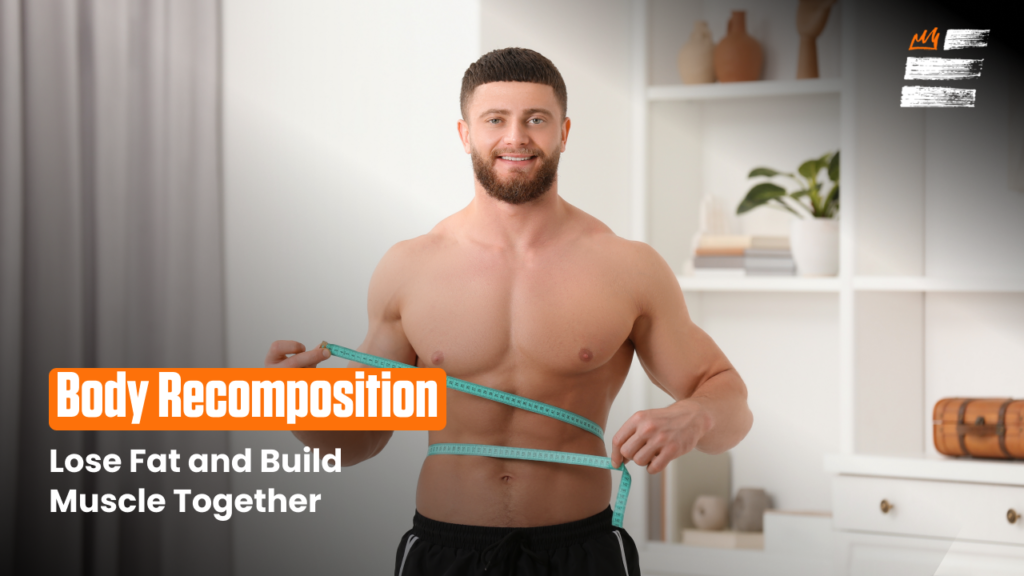
If you have ever been told you must “bulk” first and “cut” later, this article is for you. Body recomposition is the alternative: lose fat and build muscle at the same time, with one plan and no extreme phases.
Your body looks different in the mirror long before the scale agrees. We have coached hundreds of Brooklyn professionals through exactly this process, and the steps below are the ones that keep working.
We will be direct with you about one thing up front. Recomp is slower than a hard cut and less dramatic than a bulk. It is also the approach we would pick for almost anyone who is not preparing for a physique competition, because the result is a body you can actually keep.

What is body recomposition, and how is it different from weight loss?
Body recomposition is the process of reducing body fat while maintaining or increasing lean muscle mass, often with little or no change in total body weight. Think of it like renovating a house without changing the footprint. The square footage stays the same, but the layout, the quality, and the value all improve.
Weight loss only tracks one number: total mass. That number cannot tell you whether you lost 5 pounds of fat or 3 pounds of fat plus 2 pounds of muscle.
Body composition (the ratio of fat mass to fat-free mass, meaning muscle, bone, and water) tells you what your weight is made of. That is why it predicts health and appearance far better than the scale or BMI, and why body recomposition vs weight loss is not a fair fight for anyone who cares how they look and move.
The practical difference shows up in how you eat and train. A weight loss diet asks you to eat less and move more. A body recomposition plan asks you to eat slightly less, eat far more protein, and lift progressively heavier weights so your body pulls energy from fat stores while it builds tissue.
Can you really lose fat and build muscle at the same time?
Yes. The old objection was that muscle growth needs a calorie surplus and fat loss needs a calorie deficit, so you cannot have both. That logic ignores where the energy comes from.
Stored body fat is fuel. A body with enough protein and a training stimulus will use that fuel to support muscle repair even while total intake sits a little below maintenance.
The research settled this a while ago. A 2020 review in the Strength and Conditioning Journal (published by the NSCA) examined randomized controlled trials in resistance-trained adults and found repeated evidence of simultaneous fat loss and muscle gain. The two deciding factors were progressive resistance training and evidence-based nutrition.
A September 2024 editorial in Frontiers in Nutrition went further. It states that recomp has been demonstrated in untrained, trained, and highly trained populations across age groups.
Who sees the fastest results? Three groups, in our experience and in the literature:
- Beginners and returning lifters: the body responds to new stimuli quickly, so the first 12 weeks can be striking.
- People with higher body fat: more stored energy makes it easier to build while in a deficit. You can absolutely recomp at 20 percent body fat or above.
- Anyone coming back after time off: regaining lost muscle happens faster than building it the first time.
Advanced lifters near their genetic ceiling will find recomp slow. That is the honest limitation, and for that group a dedicated bulk and cut cycle is often the better call.
How does body recomposition work? The four levers
Body recomposition works by combining a mild energy deficit with a strong muscle-building signal, so your body has both a reason to burn fat and a reason to keep or add muscle.
Pull any one of the four levers below on its own and you get either fat loss with muscle loss, or muscle gain with fat gain. Pull all four and you get recomp.
| Lever | What it does | The number that matters |
| Small calorie deficit | Forces the body to draw on fat stores | 100 to 300 calories below maintenance per day |
| High protein intake | Supplies the raw material for muscle repair and protects lean mass | 1.6 to 2.2 g per kg of body weight (0.7 to 1.0 g per lb) |
| Progressive resistance training | Gives muscle a reason to grow | 2 to 4 sessions per week, adding load or reps over time |
| Recovery | Lets adaptation actually happen | 7 to 9 hours of sleep, 48 hours between hitting the same muscle group |
This is the framework we use for body composition coaching in Brooklyn, and it does not change much from client to client. What changes is the calibration: how big the deficit, how many sessions, how much protein a given person can realistically eat.

How much protein do you need for body recomposition?
Aim for 1.6 to 2.2 grams of protein per kilogram of body weight per day (roughly 0.7 to one gram per pound).
This is the single most important nutrition rule in recomp. Protein is what stops a calorie deficit from eating your muscle along with your fat.
That floor is not a guess. A 2018 meta-analysis in the British Journal of Sports Medicine, pooling 49 trials and 1,863 participants, found that muscle gains from resistance training kept rising with protein intake up to about 1.62 g/kg per day and plateaued after that.
A 2022 dose-response meta-analysis in Sports Medicine Open put the strength plateau at a similar 1.5 g/kg per day.
In a deficit, we push toward the higher end of the range. Protein also keeps you full, which matters when you are eating less.
| Body weight | Daily protein target (1.6 to 2.2 g/kg) | What that looks like |
| 130 lb (59 kg) | 95 to 130 g | Chicken breast at lunch, Greek yogurt, eggs, one shake |
| 160 lb (73 kg) | 115 to 160 g | Add a second palm-sized protein portion at dinner |
| 190 lb (86 kg) | 140 to 190 g | Four protein-centered meals, each 35 to 50 g |
| 220 lb (100 kg) | 160 to 220 g | Five feedings or two shakes alongside three meals |
A practical shortcut: build every meal around a protein source first, then add carbohydrates and fat around it. Three to five feedings beat one giant dinner for both muscle and appetite.
What does a body recomposition diet look like?
A body recomposition diet sits at or slightly below maintenance calories, keeps protein high, and fills the rest with mostly whole foods. That is the entire recipe. The mistake we see most often is people treating recomp like a cut: slashing 700 or 800 calories, doing hours of cardio, and then wondering why they feel flat and lose strength.
Here is how to set it up:
- Estimate maintenance calories. Track what you eat for one normal week while your weight holds steady, or use a calculator as a starting point. Adjust after two weeks based on real data.
- Subtract 100 to 300 calories. Go smaller if you are lean or training hard, larger if you have more fat to lose.
- Set protein first. Multiply body weight in kilograms by 1.6 to 2.2. Lock that number.
- Fill the rest with carbohydrates and fat. Carbohydrates fuel training and spare protein; a common split puts 30 to 35 percent of calories in protein, 30 to 35 percent in carbohydrates, and the rest in fat, but the exact ratio matters far less than the calorie and protein targets.
- Consider calorie cycling. Eating a little more on your two hardest training days and a little less on rest days lets you keep a weekly deficit while fueling the sessions that build muscle. The 2024 Frontiers in Nutrition editorial specifically notes that intermittent, progressive energy restriction paired with high protein appears to preserve fat-free mass better than a constant aggressive deficit.
One caveat. If you are on a GLP-1 medication such as semaglutide or tirzepatide, appetite suppression makes hitting protein targets harder, and the risk of losing muscle rises sharply.
Our guide on preventing muscle loss on Ozempic or Wegovy covers how to adjust.

What is the best body recomposition workout plan?
The best body recomposition workout plan is a strength training program built around compound lifts, run two to four days per week, with a clear rule for progressive overload. Cardio is the supporting cast, not the lead.
The CDC’s adult activity guidance (last reviewed December 2023, republished December 2025) calls for muscle-strengthening work on at least two days a week covering all major muscle groups, plus 150 minutes of moderate cardio. For recomp, we treat that as the floor.
Progressive overload (gradually increasing the weight, reps, or sets over time) is the mechanism that tells muscle to grow. Without it, you are exercising, not training. A simple rule: when you can hit the top of your rep range on every set with good form, add weight next session.
| Day | Focus | Example |
| Day 1 | Lower body | Squat pattern, hinge pattern (Romanian deadlift), lunge, calves |
| Day 2 | Upper body | Horizontal press, horizontal row, vertical pull, overhead press |
| Day 3 | Rest or 30 minutes brisk walking | Low intensity, easy to recover from |
| Day 4 | Full body | Deadlift or trap bar, incline press, split squat, carries |
| Day 5 | Optional conditioning | 20 to 25 minutes of intervals or a longer walk |
| Weekend | Rest, mobility, active recovery | Sleep is the priority |
For most lifts, 3 sets of 6 to 12 reps taken close to failure covers hypertrophy (muscle growth) well. Higher volume is not better if it costs you recovery.
If you are unsure whether your form or program is doing the job, a coached open gym with a professional on the floor is the cheapest way to find out.

How long does body recomposition take?
Expect visible changes in 8 to 12 weeks and a noticeably different body in 4 to 6 months. Beyond that, recomp becomes a maintenance lifestyle rather than a project with an end date. Those timelines assume you hit protein, train consistently, and sleep.
| Starting point | First visible change | Meaningful change |
| Beginner or returning after a long break | 6 to 8 weeks | 3 to 4 months |
| Higher body fat, some training history | 8 to 12 weeks | 4 to 6 months |
| Lean and already trained | 12 weeks or more | 6 to 12 months, and slower each year |
We tell clients to picture the scale as a broken instrument for this goal. A pound of fat and a pound of muscle weigh the same; muscle simply takes up less room. Lose three pounds of fat and gain three of muscle and the scale reports nothing happened, even though your waist shrank an inch.
How do you track body recomposition progress?
Track body recomposition with progress photos, waist and hip measurements, strength logs, and how clothes fit, then treat scale weight as a distant fifth. Photos every four weeks in the same light and pose reveal what no single number can.
If you want data, body fat percentage from a DEXA scan (the clinical gold standard) or a quality bioelectrical impedance device gives a baseline and a repeatable comparison. Just use the same method each time; comparing a DEXA reading to a bathroom smart scale is comparing two different rulers.
Strength is the metric people forget. Working weights climbing while your waist shrinks means you are recomping, whatever the scale says.
Who should not attempt body recomposition?
Body recomposition is safe for most healthy adults, but it is the wrong tool for a few groups. Advanced lifters near their limit will progress faster with dedicated bulk and cut phases.
Anyone with a history of disordered eating should be cautious about calorie and macro tracking, and may do better with a habit-based approach guided by a professional.
People managing a medical condition, pregnancy, or hormonal changes such as perimenopause should clear the plan with their physician first. Our perimenopause and strength training guide covers that transition in detail.
Recomp also fails, predictably, for people who try to do it on five hours of sleep. Recovery is not optional here. Skip it and the deficit wins, muscle loses.
Body recomposition in Brooklyn: where to get coaching
If you are in Brooklyn and want someone to run this process for you, we recommend Physical Culture Brooklyn, our coaching gym at 55 Ninth Street, Unit 4A, in Gowanus (Brooklyn, NY 11215).
The body composition program pairs you with a dedicated coach. It starts with a baseline body composition test and movement screen, then builds a training and nutrition plan around your schedule rather than a template.
We are biased, obviously. So do not take our word for it. Take the free 5-minute fitness evaluation first; you may find you can run recomp on your own with the framework above.
If you would rather compare options, our guide to finding the right coach in Brooklyn explains what to look for and what a session should cost. Call or text 917-946-3000 with questions.
Frequently asked questions
Can you lose fat and gain muscle at the same time?
Yes. Body recomposition is the name for doing exactly that. It requires a small calorie deficit, high protein intake, progressive strength training, and adequate sleep.
Peer-reviewed reviews from 2020 and 2024 confirm it happens in beginners, people with higher body fat, and resistance-trained adults. It is slowest in very lean, advanced lifters.
How long does body recomposition take?
Most people notice visible changes in 8 to 12 weeks and significant changes in 4 to 6 months. Beginners and people carrying more body fat tend to see results sooner.
Lean, experienced lifters should plan for 6 to 12 months and expect slower progress each year. Recomp works best when you treat it as an ongoing lifestyle instead of a fixed program.
What are good body recomposition macros?
Set protein first at 1.6 to 2.2 g per kg of body weight, then fill remaining calories with carbohydrates and fat.
A common starting split is 30 to 35 percent protein, 30 to 35 percent carbohydrates, and 30 to 40 percent fat. The exact ratio matters less than hitting your calorie target and protein floor consistently, so adjust the carb-to-fat balance around what you enjoy and what fuels your training.
Can you recomp at 20 percent body fat?
Yes, and it is one of the best starting points. At 20 percent body fat or higher your body has plenty of stored energy to fuel muscle repair while you eat slightly below maintenance.
Keep the deficit around 100 to 300 calories, prioritize protein, and train with progressive overload. Track measurements and photos rather than scale weight, which may barely move.
Do you need cardio for body recomposition?
Cardio helps but does not drive recomp. Strength training builds muscle; nutrition handles the fat loss. Two or three short sessions a week of walking, cycling, or intervals support heart health and add a modest calorie burn without cutting into recovery. Avoid long daily cardio sessions, which can blunt strength progress and increase hunger in a deficit.
Do you need supplements for body recomposition?
Whole food covers most needs. Two supplements have strong evidence: protein powder, if you struggle to reach your daily protein target from meals, and creatine monohydrate, which the 2024 Frontiers in Nutrition editorial on recomposition describes as a valuable strategy for supporting lean mass.
Fat burners and most other products add little beyond what the four levers already deliver.