What is perimenopause, exactly, and are the changes you’re feeling part of it? Perimenopause is the hormonal transition your body makes in the years before menopause, and the signs of perimenopause, from irregular periods to disrupted sleep, usually arrive earlier on the timeline than most women expect. I coach women through this transition every week on our gym floor in Gowanus, Brooklyn, and here’s my honest position up front: a good strength coach is the most underused resource for this life stage. Not a supplement. Not a 30 day challenge. Coach lifting.
I’m a women’s health coach in Brooklyn, not a physician, so this article covers what the medical sources say about the signs and the perimenopause timeline, then goes deep on the part I know from coaching hundreds of sessions: what happens to your muscle and bone, and how a strength coach (or the right personal trainer in Brooklyn) helps you protect both. For diagnosis or treatment, always talk to your healthcare provider.
What Is Perimenopause, and How Is It Different From Menopause?
Perimenopause is the transitional phase before menopause when your ovaries gradually wind down, causing estrogen and progesterone to fluctuate and then decline. Menopause itself is a single point in time: the day you’ve gone 12 consecutive months without a period, as defined by the Cleveland Clinic. Everything leading up to that point is perimenopause; everything after is postmenopause.
The distinction matters for training. During the menopause transition, hormones don’t fall in a straight line, they swing. That’s why symptoms can come and go, why energy varies wildly week to week, and why a rigid training program that ignores those swings tends to fail. The women I coach do best with structured flexibility: a consistent plan that adapts to how a given week actually feels.
When Does Perimenopause Start and How Long Does It Last?
Most women begin perimenopause in their 40s. According to a 2026 review by BodySpec, citing research by Gold and colleagues, the median start age is around 47, with a normal range spanning the mid 30s to the early 50s. The Cleveland Clinic puts the average length at about four years, though it can last up to eight, and some clinicians report transitions of a decade or more. Per Franciscan Health (May 2025), women who smoke generally reach menopause two to three years earlier than nonsmokers.
| Stage | Typical age | What’s happening |
| Late reproductive years | Late 30s to early 40s | Subtle cycle changes; hormones begin fluctuating |
| Early perimenopause | Often mid 40s (median start around 47) | Irregular periods, first symptoms appear |
| Late perimenopause | Varies; final years before last period | Cycles far apart, symptoms often peak, bone loss accelerates |
| Menopause | Confirmed after 12 months with no period | The transition ends; postmenopause begins |
One thing I tell every client: the timeline is a range, not a schedule. Two women the same age can be in completely different places hormonally, which is exactly why cookie cutter midlife fitness advice falls short.
What Are the First Signs of Perimenopause?
The signs of perimenopause usually build gradually, and the earliest ones are easy to attribute to stress or a busy life. Per the Cleveland Clinic and Franciscan Health, the most common include:
- Irregular periods. Almost always the first sign: cycles get shorter, longer, heavier, lighter, or skip entirely.
- Hot flashes and night sweats. Often appearing months or years after cycle changes begin.
- Sleep problems. Trouble falling asleep or staying asleep, sometimes independent of night sweats.
- Mood shifts and brain fog. Hormonal swings affect neurotransmitters, which can show up as irritability, anxiety, or fuzzy focus.
- Changes you can’t see. Declining estrogen quietly affects muscle, bone density, and metabolism, the changes this article is really about.
If several of these sound familiar, bring them to your doctor or gynecologist. Symptom tracking plus a clinical conversation beats guessing, and combined birth control can mask cycle changes, so the visible signs aren’t always reliable on their own.
What Happens to Muscle and Bone During Perimenopause?
This is the part of the menopause transition nobody feels day to day, and it’s the part that shapes the next 40 years of your life.
Muscle first. Research summarized by The Better Menopause (March 2026) suggests muscle mass declines 3 to 8 percent per decade after age 30, and that loss accelerates as estrogen falls. Estrogen supports the satellite cells that regenerate muscle tissue, so perimenopause and muscle loss travel together unless you actively push back. Less muscle also means a slower resting metabolism, which is one reason midlife weight gain is so common even when nothing about your eating changed.
Bone is the quieter emergency. According to Progressive Physical Therapy (November 2025), up to 20 percent of a woman’s lifetime bone loss happens during the menopause transition. Estrogen is a key regulator of bone density, and when it declines, the risk of osteopenia and eventually osteoporosis climbs. This isn’t theoretical for me: in my own practice I’ve supported clients managing osteoporosis, osteopenia, back pain, pelvic floor issues, and hormonal transitions including perimenopause and menopause, and I can tell you the easier conversation, by far, is the preventive one at 45, not the reactive one at 65.
How Can a Strength Coach Help During Perimenopause?
A strength coach helps in two specific ways during the menopause transition: writing programming that loads muscle and bone safely, and adjusting that plan week to week as hormones swing. The second part is where self-directed training usually breaks down, because a program that ignores fluctuating energy and recovery tends to get abandoned by month two.
Here’s the underlying mechanism in one sentence: resistance training loads your bones, that load signals bone forming cells called osteoblasts to build denser tissue, and denser bone means lower fracture risk. Sports medicine physicians at Andrews Sports Medicine (October 2025) call strength training one of the best things you can do for your bones during perimenopause, with studies showing it can maintain or even improve density in the fracture prone hips and spine. The same work builds muscle, improves balance, protects joints, supports mood, and helps manage the metabolic slowdown.
Most medical guidelines land on strength training at least two days per week covering all major muscle groups. My programming for perimenopausal clients centers on the fundamental patterns (squat, hinge, press, pull, carry) with progressive overload, meaning the weight goes up gradually as your body adapts. Walking and yoga are wonderful, but neither loads bone the way lifting does.
An honest caveat: strength training is not a cure for perimenopause symptoms, and it won’t replace medical care. Hot flashes, for instance, are largely hormonal and may warrant a conversation with a menopause informed clinician about treatment options. What lifting reliably does is protect the muscle, bone, and metabolic health that hormones stop protecting for you. If you have osteoporosis, prolapse, or pelvic floor symptoms, work with a qualified personal trainer in Brooklyn or a physical therapist first, because exercise selection genuinely matters in those cases.
How Should Women in Brooklyn Start Strength Training During Perimenopause?
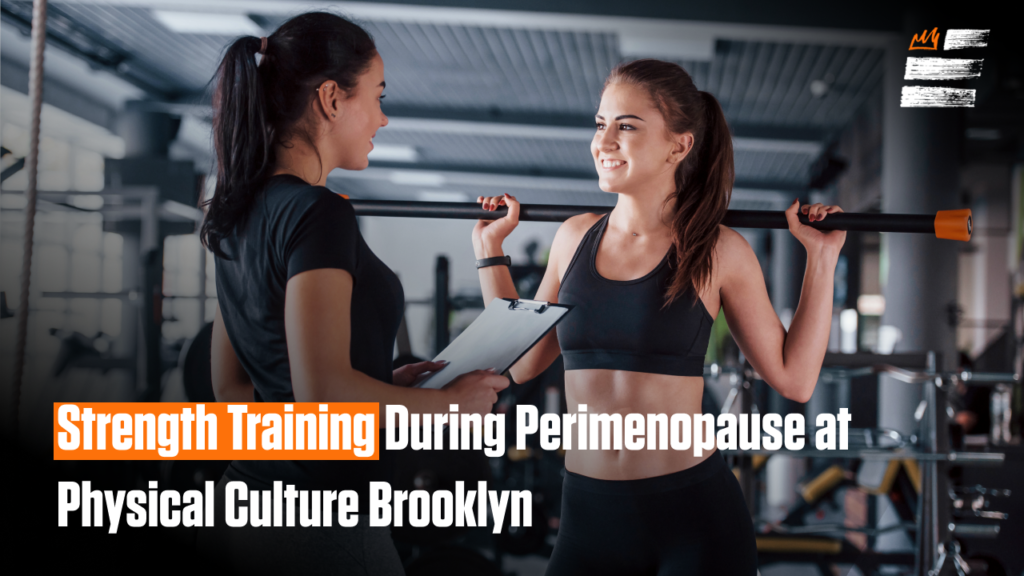
Here’s the path I use with new clients at Physical Culture Brooklyn, our coaching gym in Gowanus, a short walk from Park Slope, Carroll Gardens, and Cobble Hill:
- Start with an assessment, not a workout. I review your training, medical, and lifestyle history, run a movement screen, and take a baseline InBody body composition scan that tracks muscle mass, not just weight.
- Learn the five patterns under supervision. Squat, hinge, press, pull, and carry, taught one on one through my women’s health coaching program, with modifications for pelvic floor, joint, or bone density concerns.
- Progress the load gradually. Two to three sessions weekly, adding weight in small increments. Consistency over intensity, every time.
- Retest every four weeks. Muscle and bone respond slowly, so I track progress with scans and strength benchmarks rather than the bathroom scale.
- Graduate toward independence. Many clients eventually train on our coached open gym floor with a program I write and adjust weekly.
One piece of buying advice, since I get asked this constantly: any personal trainer in Brooklyn can write you a workout, but perimenopause programming is a specialty. Look for pregnancy, postpartum, or menopause specific credentials (PCES, P&PA, or equivalent) rather than a general certification alone. A women’s health coach in Brooklyn who understands pelvic floor mechanics and bone density considerations will program very differently than a general trainer, and at this life stage, that difference shows up in your results.
You’ll find me on the gym floor Monday mornings (6 AM to 12 PM) and Wednesday evenings (3 PM to 9 PM) at 55 Ninth St, Unit 4A, Brooklyn, NY 11215. Call or text (917) 946-3000, or stop by if you’re nearby in Gowanus.
What Clients Say About Training Through Midlife
I’d rather show you real voices than tell you how coaching feels. These reviews are published on our site and Google profile, from clients who trained with me for years, not weeks.
| “I’ve been working with Coach Chantel for nearly two years and have always felt that I’ve been in good hands; she really takes the time to understand your lifestyle and health goals, and creates a program that is effective, realistic, and sustainable.”Tracey L., rated 5 out of 5 |
| “I’ve been a member for 1.5 years and I’ve learned so much, gotten in great shape, and really enjoyed the journey (special thanks to my coach Chantel!). I really like that there is a wide range of fitness levels and ages at this gym as well, so it feels both not intimidating and inspiring at the same time.”Alison R., rated 5 out of 5 |
| The bottom linePerimenopause is a years-long hormonal transition, not a switch, and its biggest physical costs, muscle loss and bone loss, are largely invisible until they aren’t. Prioritize a medical checkup if symptoms are disrupting your life. Prioritize strength training now, at least twice a week, if you want to enter your postmenopausal decades strong, mobile, and independent. If you’re in Brooklyn and want expert guidance, book an intro call and let’s build your plan together. |
Frequently Asked Questions
Is 45 too early for perimenopause?
No. Age 45 sits comfortably within the normal range. The median start age is around 47, but the transition can begin anywhere from the mid 30s to the early 50s. If your periods have become irregular or symptoms are stacking up, track them and talk to your provider, especially if your cycle stops for more than three months.
How long does perimenopause last?
About four years on average, according to the Cleveland Clinic, though it can last up to eight, and some women experience transitions closer to a decade. It officially ends at menopause, which is confirmed only after 12 consecutive months without a period. The length varies so widely that comparing your timeline to a friend’s rarely tells you much.
What is the difference between perimenopause and menopause?
Perimenopause is the transition, the years of fluctuating hormones and irregular cycles leading up to your final period. Menopause is a single milestone: the point at which you’ve gone 12 straight months without menstruating. After that, you’re postmenopausal. Most of the symptoms people associate with menopause actually happen during perimenopause.
Can strength training help perimenopause symptoms?
It reliably helps the structural changes: muscle loss, bone density decline, metabolic slowdown, balance, and often sleep and mood. It’s not a treatment for hormonal symptoms like hot flashes, which belong in a conversation with your clinician. Think of lifting as protecting what estrogen used to protect, while your medical team addresses the hormones themselves.
How many days a week should I strength train during perimenopause?
At least two days per week covering all major muscle groups, which is the floor most medical guidelines agree on. In my coaching practice, two to three well structured sessions weekly with progressive overload produces steady results without draining the energy this life stage already taxes. Recovery is part of the program, not a failure of it.
Where can I find a women’s health coach in Brooklyn for perimenopause?
Physical Culture in Gowanus offers women’s health coaching for perimenopause, menopause, prenatal, and postpartum clients, serving Park Slope, Carroll Gardens, Cobble Hill, and nearby neighborhoods. When comparing any personal trainer in Brooklyn, ask about women’s health specific credentials. I hold a B.S. in Exercise Science plus PCES, P&PA, and PRI certifications, and every program starts with a movement screen and body composition baseline. Call or text (917) 946-3000.