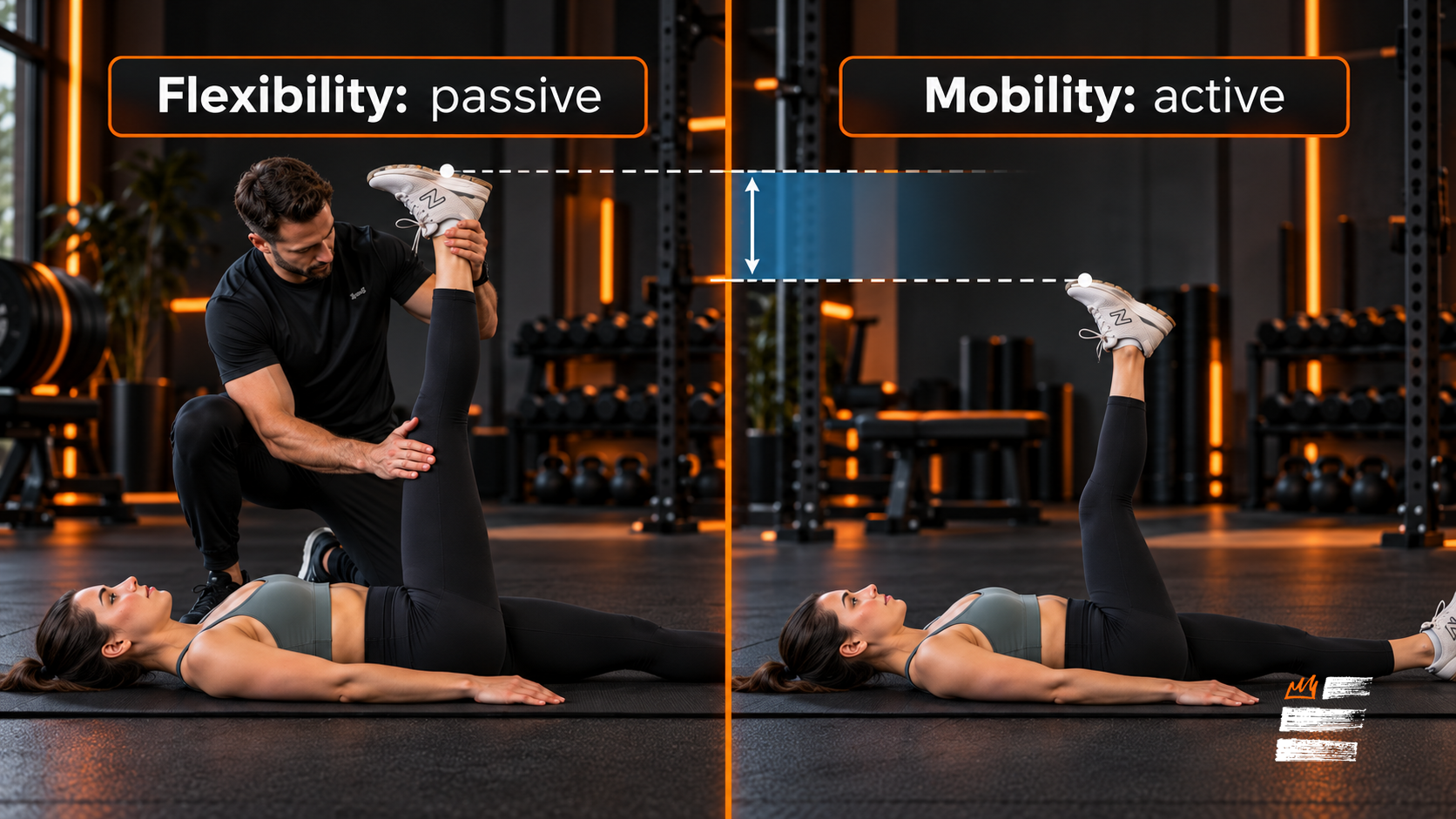
mobility vs flexibility in 30 seconds
- Flexibility is passive range. It is how far a muscle can lengthen when something else does the work: gravity, a strap, a partner or your hands.
- Mobility is an active range. It is how far you can move a joint on your own, with strength and control. Mobility needs flexibility, but flexibility does not guarantee mobility.
- The gap between the two is the problem. If you can stretch into a deep position but cannot control it, that range will not show up under a barbell.
- Lifting builds range too. A 2021 meta-analysis of 11 trials (452 people) found strength training and stretching improved range of motion by similar amounts.
- Stretch smart, not long. Use dynamic stretching before training. Static holds under 60 seconds per muscle barely affect performance; long holds cost more.
- Start with a movement screen. The fix for a stiff ankle looks nothing like the fix for a stiff upper back, so find the actual limit first.
What is the difference between mobility and flexibility? That question comes up in almost every assessment we run at our Gowanus gym. A client touches their toes with ease, then folds at the bottom of a goblet squat. Another feels loose on the foam roller but cannot press overhead without arching their back.
The short version: mobility vs flexibility is the difference between range you own and range you borrow. Flexibility tells you what your tissues allow. Mobility tells you what you can actually use when you lift, sprint, grapple or pick up your kid.
Here’s the one-paragraph answer. Flexibility is the passive ability of muscles and connective tissue to lengthen, usually measured with outside help. Mobility is the active ability to move a joint through its range of motion with strength, stability and motor control. You need some flexibility to be mobile, but training mobility means building strength and control at the end range, not just stretching further.
We’ll say this up front: we screen plenty of people who stretch every day and still move poorly. The stretching was fine. The control was missing. Keep that in mind as you read.
What is the difference between mobility and flexibility?
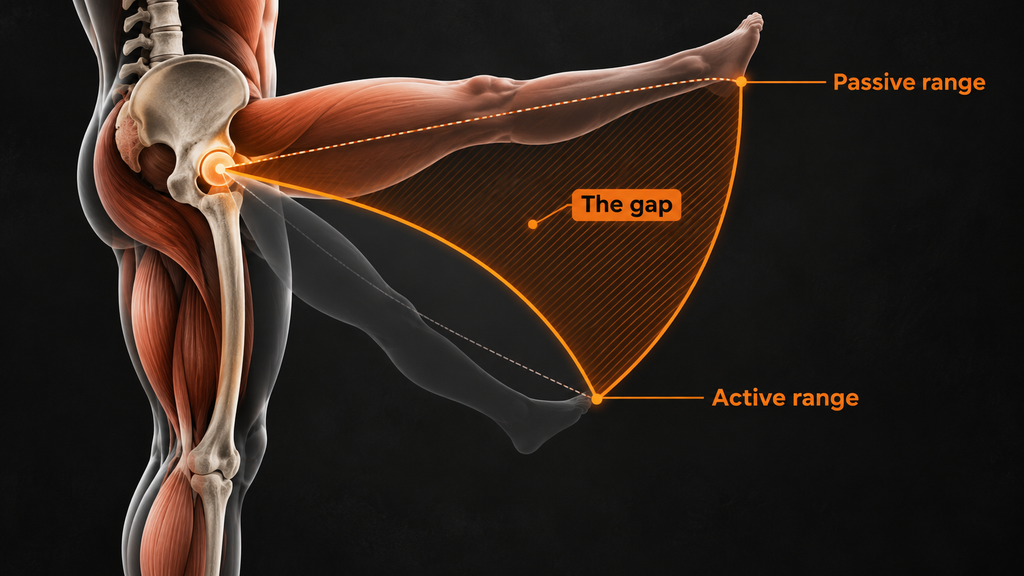
The difference between mobility and flexibility is who does the work. With flexibility, an outside force moves you into range. With mobility, your own muscles take the joint there and hold it. Both describe range of motion, but only mobility includes the strength and coordination to use it.
Think of it like a car’s steering. Flexibility is how far the wheels can physically turn. Mobility is how well you can steer through a tight corner at speed. Wide wheel travel is useless if you cannot control it.
| Quality | Flexibility | Mobility |
|---|---|---|
| Type of range | Passive | Active |
| Who does the work | Gravity, a strap, a partner or your hands | Your own muscles |
| Main tissues | Muscles, tendons, fascia | Muscles plus the joint capsule and nervous system |
| What it depends on | Tissue extensibility and stretch tolerance | Flexibility, strength, stability and motor control |
| Simple test | Partner-assisted straight-leg raise | Active straight-leg raise, deep bodyweight squat |
| How to train it | Static stretching, passive holds | Active drills, controlled rotations, loaded full-range lifts |
| Payoff for lifters | Less stiffness, more available range | Better positions under load, fewer compensations |
The gap between your passive and active range is the number that matters. Your nervous system tends to restrict range it cannot control. So if your passive range is far bigger than your active range, that extra range rarely shows up in your squat, press or deadlift. Closing that gap is what mobility training is for.
What is flexibility training?
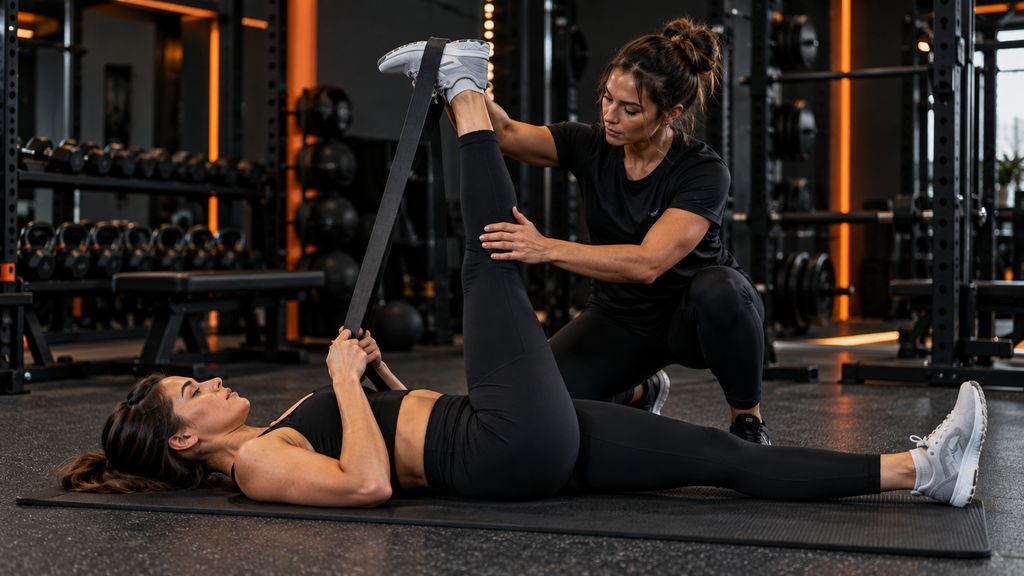
Flexibility training is any method that increases passive flexibility, how far a muscle can be lengthened with outside help. Static stretching, partner stretching, band-assisted holds and long yoga poses all fall here.
The quality being trained is tissue extensibility: how much your muscles, tendons and fascia tolerate being lengthened. Much of the early gain is not the muscle physically growing longer. It is your nervous system becoming more tolerant of the stretch, so it lets you go further before it says stop.
A seated hamstring stretch is the classic example. Gravity and your arms pull you forward, and your hamstrings lengthen. That shows flexibility. It says nothing about whether you can control that range under a loaded barbell or at the bottom of a sprawl.
Flexibility training still earns its place for three groups of people:
- Athletes in range-heavy sports, like Brazilian jiu-jitsu, gymnastics, dance and martial arts, where extreme passive range is part of the skill.
- People with a clear restriction found on a movement screen, such as hip flexors that block full hip extension.
- Anyone who feels better for it. Light static stretching after a session or before bed is a reasonable way to wind down.
What is mobility training?
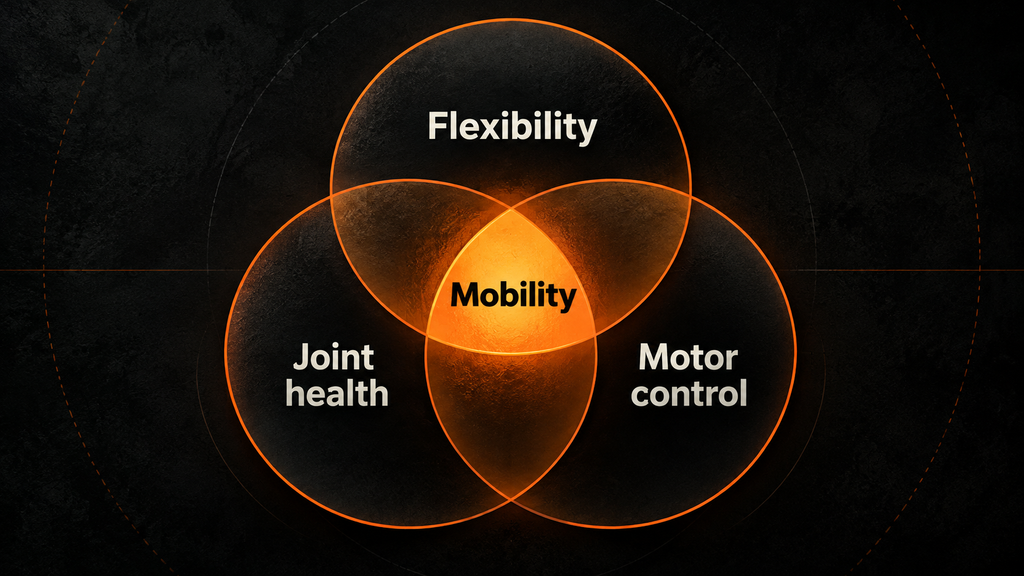
Mobility training is training that builds active mobility: the ability to move a joint through its full range under your own power, then stay strong and stable there. No strap, no partner and no gravity doing you a favor.
Mobility rests on three things working together:
- Flexibility. The muscles and connective tissue have to be able to lengthen.
- Joint health. The joint capsule and joint surfaces need to allow the movement. A stiff capsule can block range that no amount of hamstring stretching will fix.
- Motor control. Your brain has to recruit the right muscles at the right time, especially near the end of the range.
The goal is end range control: being able to produce force and hold position at the edges of your movement, not just reach them. That is why mobility training looks different from a stretching class. Expect slow controlled joint rotations, active holds at end range, and full-range lifts like deep goblet squats and Romanian deadlifts.
A simple self-check: lie on your back and raise one straight leg as high as you can without using your hands. Then have someone lift it for you. The difference between the two heights is the range you only borrow.
Why does end range strength matter for joint range of motion?
End range strength is what turns a new joint range of motion into usable range. Most people are strong in the middle of a movement and weak at the edges. The edges are where real life happens: the bottom of a heavy squat, reaching a high shelf, catching a slip on an icy Brooklyn sidewalk.
Here is the part most stretching advice leaves out. Lifting through a full range is itself a range of motion tools. A 2021 systematic review and meta-analysis in Healthcare pooled 11 randomized trials with 452 participants and found no meaningful difference in range of motion gains between strength training and stretching (Afonso et al., 2021). The authors noted the studies varied widely in design, so the finding is a strong signal rather than the final word.
For a lifter, that changes the question. You may not need more stretching. You may need more full-range, controlled strength work. Building strength at end range does two things:
- It makes the new range usable. The range you cannot stabilize will not show up when the bar is loaded.
- It makes tissue more resilient. Muscles that are strong in long positions handle sudden loads better than muscles that have only been stretched.
This is why our coaches care less about how far you can stretch and more about how well you control the positions your training and your life demand.
Dynamic vs static stretching: which should you do, and when?
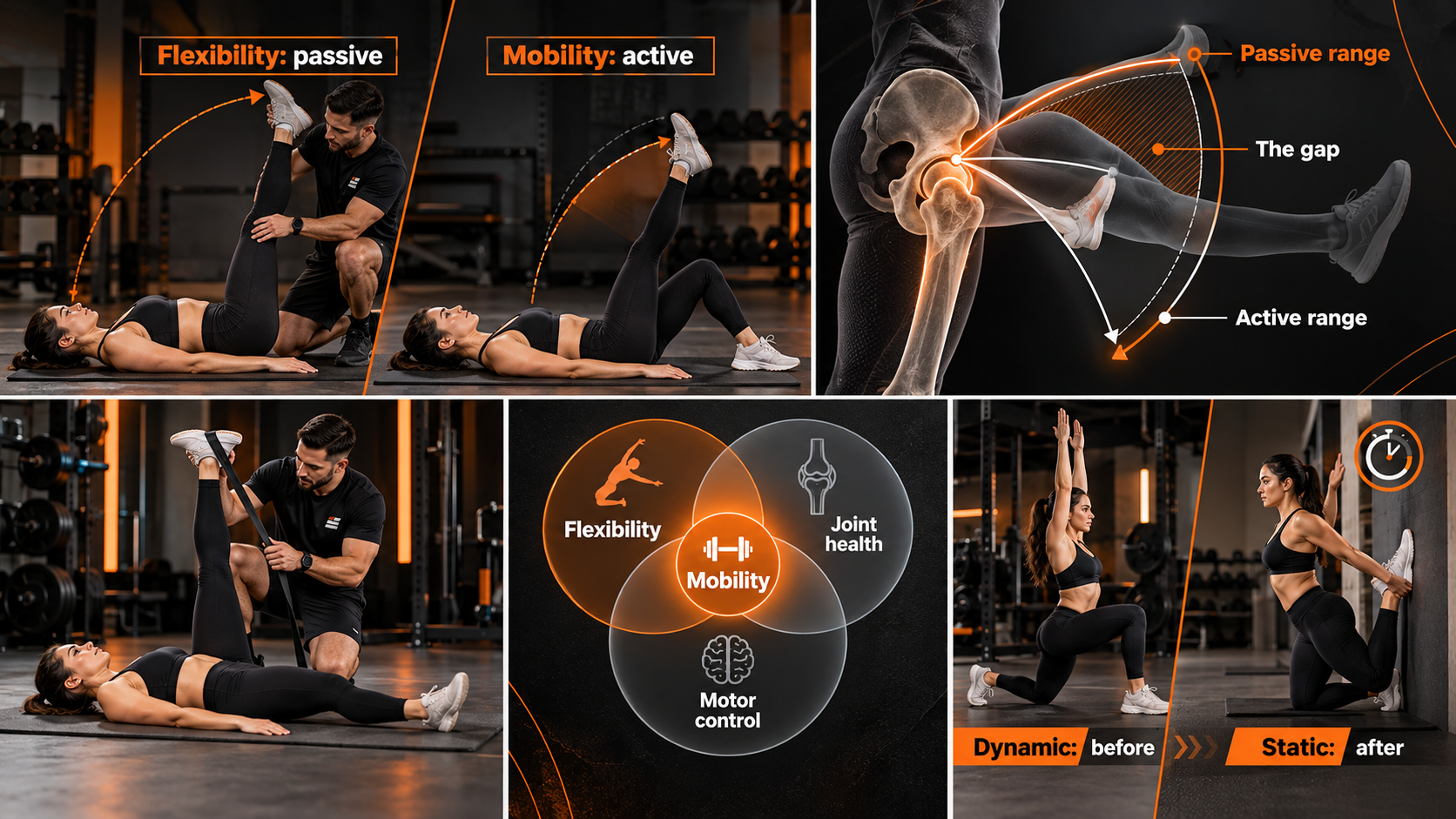
Do dynamic stretching before you train and save long static holds for after. Both improve range of motion; the difference is what they do to the session that follows.
Dynamic stretching moves a joint through its range repeatedly and under control: leg swings, walking lunges with a reach, inchworms, arm circles. It raises tissue temperature and rehearses the positions you are about to load.
Static stretching means holding a lengthened position, usually 15 to 60 seconds. It improves passive flexibility and helps you wind down.
The research on timing is clearer than most gym folklore. A 2016 systematic review by Behm and colleagues in Applied Physiology, Nutrition, and Metabolism found:
| Finding | What it means for your warm-up |
|---|---|
| Static holds of 60 seconds or more per muscle cut performance by about 4.6% | Avoid long holds right before heavy or explosive work |
| Static holds under 60 seconds cut performance by about 1.1% | Short holds in a warm-up are fine |
| Dynamic stretching improved performance by about 1.3% | Make dynamic work the core of your warm-up |
| Adding dynamic activity after stretching removed any clear performance cost | Stretch first, then finish the warm-up with movement |
Do you need to stretch?
Honest answer: probably less than you think. If you already lift through a full, controlled range, you are training mobility every session. You will benefit from dedicated stretching if a movement screen shows a clear restriction, your sport demands extreme passive range, or stiffness is limiting daily life. If none of those apply, a short dynamic warm-up and full-range strength training usually cover you.
How do you improve mobility?
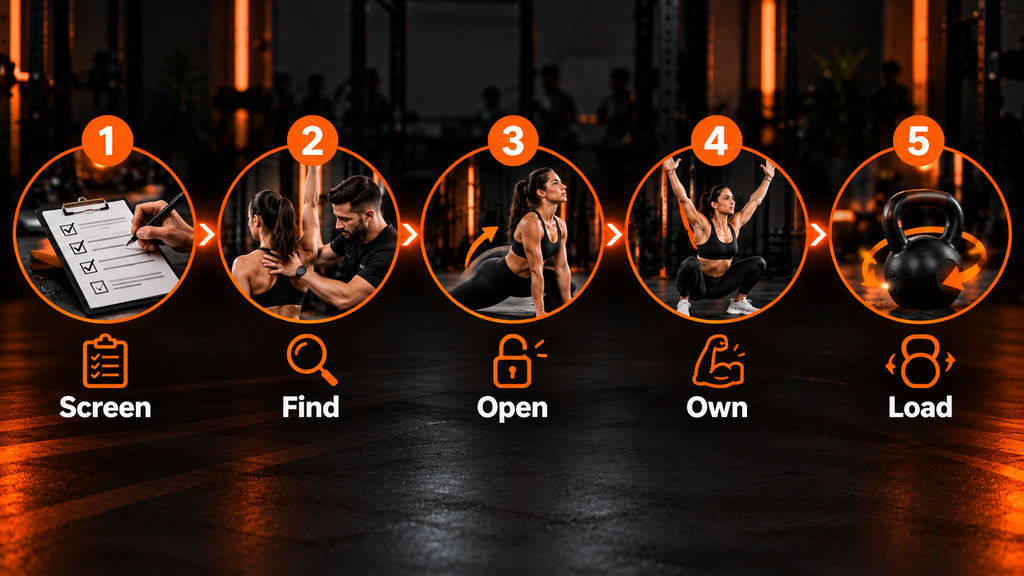
You improve mobility by finding your real limitation, opening the range, then strengthening it until it sticks. Random stretching skips the first step and the last two. Here is the sequence our coaches follow:
- Run a movement screen. A coach checks how your ankles, hips, thoracic spine and shoulders move, and where you compensate. At Physical Culture this happens during your one-hour physical assessment, alongside body composition and injury risk screening.
- Find the limiter. Decide whether the restriction is tissue length, joint position or control. A squat that improves when you elevate your heels points to the ankle, not the hips.
- Open the range. Use a short dynamic drill or a brief static stretch to access the range you are missing.
- Own the range. Follow immediately with active work: lift, rotate or hold in that new range with your own muscles.
- Load and retest. Add weight to full-range lifts so the new range becomes strong. Then retest with the same drills. We retest clients at least quarterly so progress is measured, not guessed.
Consistency beats duration. Five to ten minutes, three to five days a week, will move more than one long session on Sunday.
If you are not sure where you are limited, our free fitness evaluation is a no-pressure place to start.
Which mobility exercises work best?
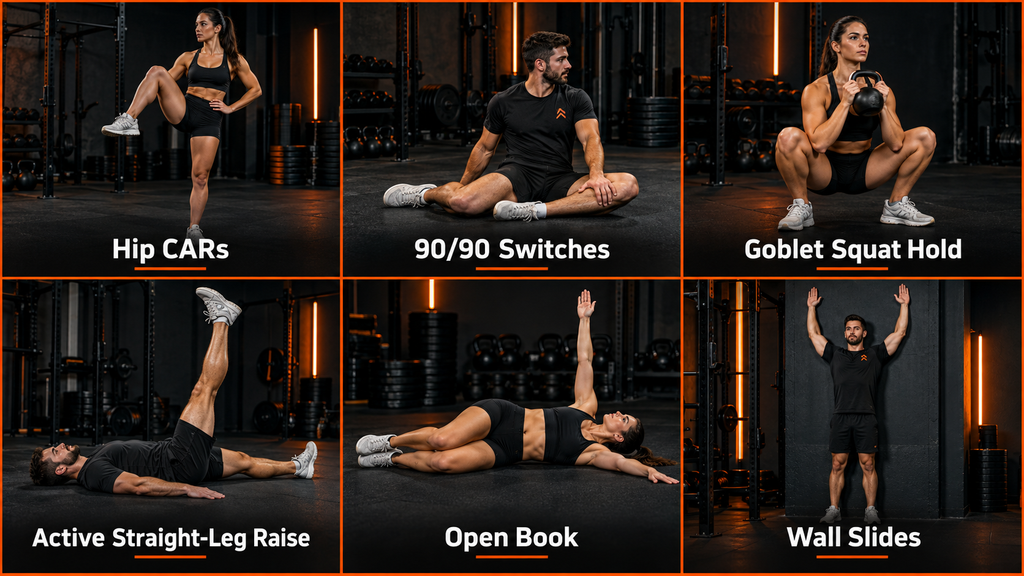
The best mobility exercises make you produce force at end range, not just reach it. These six cover the joints that limit most lifters: hips, ankles, thoracic spine and shoulders.
Hip controlled articular rotations (CARs)
Standing or on all fours, draw the biggest slow circle you can with one knee while keeping the rest of your body still. Do 3 to 5 slow circles each direction, each side. This trains hip control and moves the joint capsule through its full range.
90/90 hip switches
Sit with both knees bent to 90 degrees, one leg in front and one to the side. Rotate both knees to the other side without using your hands. Do 8 to 10 switches. This builds internal and external hip rotation, which shows up in squats, lunges and guard work on the mat.
Goblet squat hold
Hold a kettlebell at your chest and sit to the bottom of a squat for 30 to 60 seconds. Use your elbows to gently press your knees out. The weight counterbalances you, so you can own a depth you could not hold unloaded.
Active straight-leg raise
Lie on your back and raise one straight leg as high as you can without help. Hold for 2 seconds, then lower slowly. Do 8 reps per side. This closes the gap between passive hamstring flexibility and usable hip flexion.
Open book thoracic rotation
Lie on your side with knees bent. Rotate your top arm open toward the floor behind you, following it with your eyes. Do 8 reps per side. This restores upper-back rotation for pressing, overhead work and throwing.
Wall slides with lift-off
Stand with your back against a wall and slide your arms overhead. At the top, lift your hands an inch off the wall and hold for 2 seconds. Do 8 reps. This builds active shoulder flexion and end range strength overhead.
If any of these cause pain rather than effort or stretch, stop and get it assessed. Our injury rehab coaches, including a Doctor of Physical Therapy, can help you sort out what is limited and why.
What does a good mobility routine for lifters look like?

A good mobility routine for lifters takes about 10 minutes, lives inside the warm-up, and targets the joints your main lift needs that day. Most of the people we coach are professionals and parents who train two to four times a week. They do not have a spare hour for stretching, so we build mobility into every session instead of assigning it as homework that gets skipped.
| Exercise | Sets × reps or time | Main target |
|---|---|---|
| Hip CARs | 1 × 3 circles each direction, each side | Hip control |
| 90/90 hip switches | 1 × 8 | Hip rotation |
| Open book | 1 × 8 each side | Thoracic rotation |
| Wall slides with lift-off | 1 × 8 | Overhead position |
| Goblet squat hold | 2 × 30 seconds | Ankles, hips, squat depth |
| Empty-bar or bodyweight version of your first lift | 1 × 8 | Groove the pattern |
Adjust by day. On squat and deadlift days, spend extra time on the goblet hold and hip work. On pressing days, lean on the open book and wall slides. Then take your working sets through a full, controlled range. That is where mobility gains stick.
If you train in our coached open gym, your coach programs this into each session so the warm-up is already matched to the lift.
What can a flexibility test not tell you?
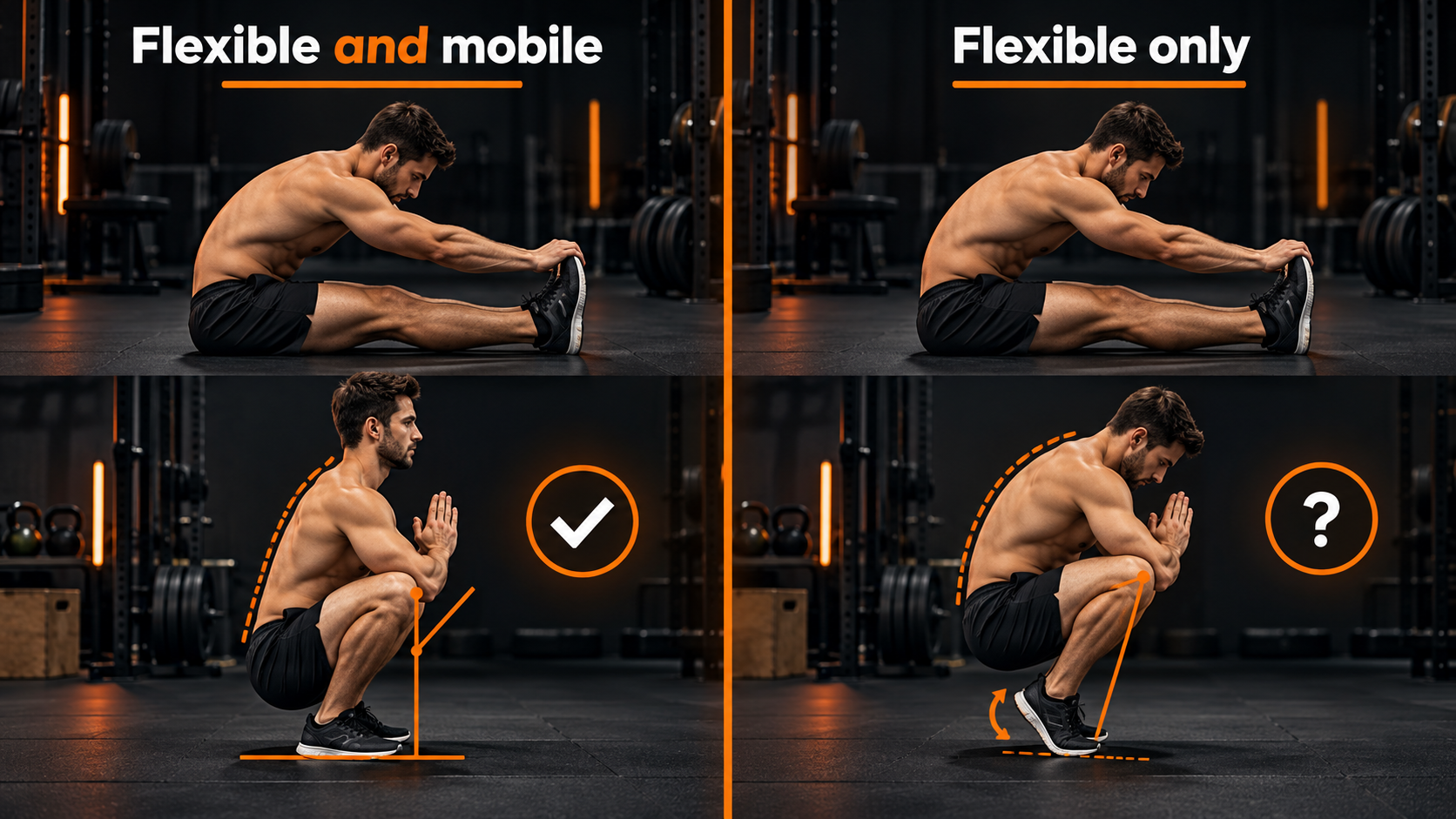
A flexibility test tells you how far you can go. It does not tell you whether you can control that range, load it or tolerate it without pain. Those are mobility and health questions, and they matter more.
Three situations show the limit clearly:
- The very flexible lifter. People with a dance, yoga or gymnastics background often pass every toe-touch test and still struggle to stabilize a lunge or a deep squat. For them, more stretching can make things worse. They need strength at the end range.
- The stiff joint that is not a tight muscle. Some restrictions come from the joint capsule, old injuries or bone structure. Hips vary in shape, and not everyone is built to squat rock-bottom with a neutral spine. Forcing range against bone does not end well.
- Range that hurts. Pain during a movement is information, not a flexibility score. It may point to an injury that needs assessment before it needs stretching.
The honest limitation: one screen is a snapshot. Range changes with sleep, stress, training load and time of day. That is why we retest with the same drills on a schedule rather than judging progress from one good or bad morning.
If an old injury keeps deciding what you can and cannot do, our injury rehab coaching bridges the gap between finishing physical therapy and training hard again. For back pain specifically, see our guide to training with lower back pain.
Frequently asked questions
Is mobility or flexibility more important?
For most people who lift or play sports, mobility matters more because it is the range you can control and use. You still need enough flexibility to support it. Extra passive range you cannot control adds little to performance and can leave a joint less stable.
Can you be flexible but not mobile?
Yes, and it is common. Many people can stretch into deep positions but lack the strength and motor control to hold them under load. It shows up often in hypermobile people and in former dancers or yoga practitioners who are new to lifting.
What is mobility training?
Mobility training builds active range of motion: moving a joint through its full range under your own power, then adding strength and load there. It uses controlled joint rotations, active end range holds and full-range lifts rather than relying on passive stretching alone.
Do you need to stretch if you lift weights?
Not always. Research comparing the two found strength training improved range of motion about as much as stretching. If you lift through a full, controlled range, you are already training in mobility. Add dedicated stretching if you have a specific restriction or your sport demands extreme range.
Should I do dynamic or static stretching before lifting?
Do dynamic stretching before lifting. Static holds under 60 seconds per muscle have only a small effect on performance, but holds of 60 seconds or longer reduce it more. If you use static stretches in a warm-up, keep them short and follow them with dynamic movement.
How long does it take to improve mobility?
Most people notice better positions within a few weeks of consistent work, three to five short sessions a week. Lasting change in joint range of motion takes longer, often a couple of months, and depends on what is limiting you. Retesting the same drills is the only reliable way to know.
Bottom line
Mobility vs flexibility comes down to control. Flexibility is passive range: what your tissues allow with outside help. Mobility is active range: what you can reach, hold and load on your own.
You need enough flexibility to support good positions. But the goal for most lifters is closing the gap between passive and active range, and full-range strength training does a lot of that work on its own.
The stretch is only as useful as the control behind it. Screen first, train the limiter, load it and retest.
Physical Culture is a coaching gym in Gowanus, Brooklyn, serving Park Slope, Carroll Gardens, Cobble Hill and the surrounding neighborhoods since 2019. Every program starts with a one-hour assessment that includes a mobility and injury risk screen.
Not sure where you are limited? Take our free fitness evaluation, or book a free consultation and we will find out together.
Last updated: October 2026.