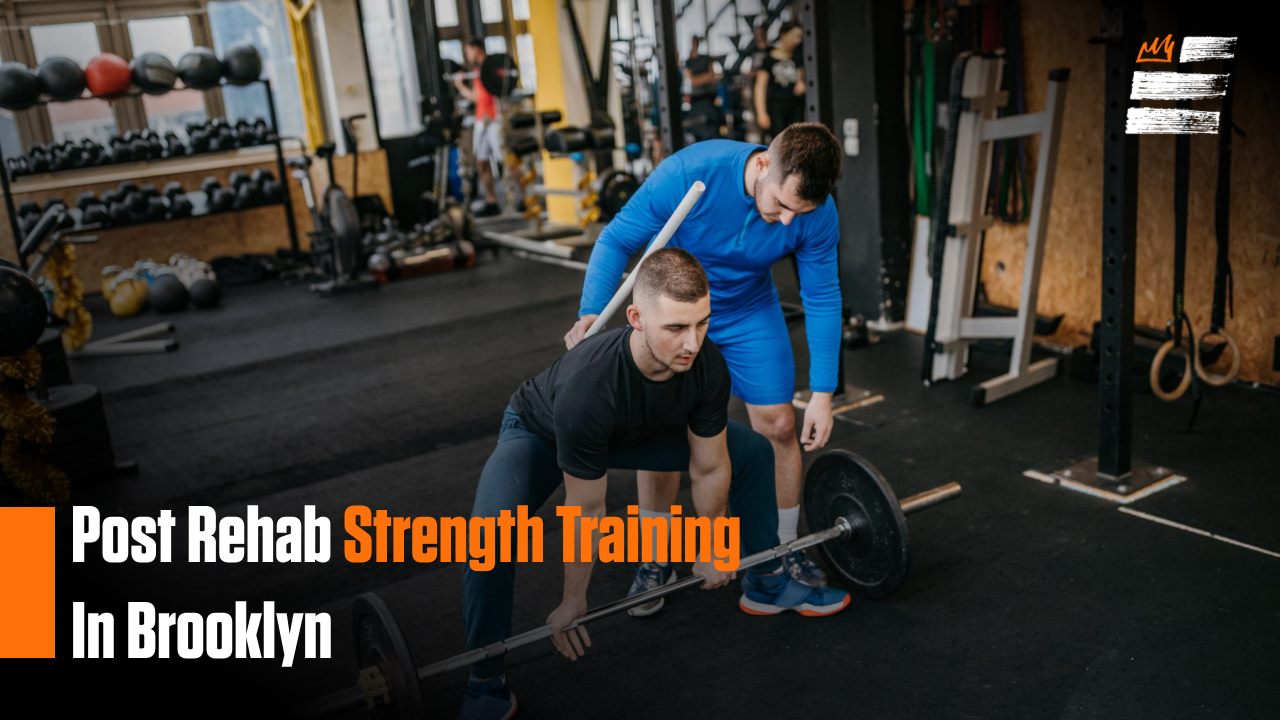
You finished physical therapy. Your physical therapist handed you a discharge sheet, told you to keep doing your home exercises, and cleared you to return to normal activity. And yet something still feels off. You hesitate before loading a barbell. You modify every movement without being sure you need to. You avoid the exercises you used to love because you do not fully trust your body anymore. If that describes where you are right now, you are not behind, and you are not being overly cautious. You are in the gap, the space between being medically cleared and being genuinely ready to train, and it is the space that post-rehab strength training in Brooklyn is built to close.
What Physical Therapy Actually Gives You (and What It Does Not)
Physical therapy has a specific and important job. It manages pain, restores basic range of motion, reduces inflammation, and gets you to the point where your injury is no longer a clinical emergency. That is valuable, and we work in close partnership with physical therapists at Ascent Physical Therapy and Flow Physiotherapy here in Brooklyn because what they do matters.
What physical therapy is not designed to do is rebuild your pre-injury strength, athletic capacity, or movement confidence. The exercises on a PT discharge sheet are baseline maintenance protocols, not progressive training programs. They are designed to prevent regression, not drive performance. Most PT programs end at the point where the clinical risk is resolved, which is typically well before the point where a person can safely and confidently return to lifting, running, sport, or the physical demands of their daily life.
The research is clear on this gap. The American College of Sports Medicine recommends that individuals returning from injury begin progressive resistance training at 8 to 12 repetitions per set, two to three days per week, with load increases of 2 to 10 percent as the current weight becomes manageable. That is a framework for safe progression that very few PT discharge programs actually implement because it requires ongoing supervision, load management, and program adjustment over weeks and months, which is exactly what post-rehab coaching provides.
Why Being Cleared by Your PT Is Not the Same as Being Ready to Train
Being cleared means your injury has progressed to the point where continued clinical management is no longer the priority. It does not mean your movement patterns are fully restored. It does not mean the compensations your body developed during injury and recovery have been addressed. And it does not mean you have the strength, stability, or body awareness to return to the intensity of training you were doing before.
Here is a common pattern we see at Physical Culture Brooklyn: a client finishes PT for a rotator cuff repair, gets cleared at 12 weeks, tries to return to the gym on their own, and immediately begins protecting the shoulder in ways that create new problems at the neck, opposite shoulder, or lower back. The injury healed. The movement pattern that protects against re-injury never got rebuilt. That is not a failure of physical therapy. It is a gap in the continuum of care that post-rehab strength training is designed to fill.
Our approach at Physical Culture Brooklyn, led by Coach June Rivera, begins with identifying exactly what the body is still compensating for after PT ends. June holds a Master’s in Exercise Science, is a certified Athletic Trainer (ATC) and Strength and Conditioning Specialist (CSCS), and brings a clinical lens to every injury rehab coaching program in Brooklyn she runs. She works with clients recovering from ACL, MCL, and LCL injuries, rotator cuff tears, lower back strains, hip and ankle injuries, and post-surgical recovery across a range of orthopedic procedures.
The Four Phases of Post-Rehab Strength Training
Post-rehab training is not one-size-fits-all, and it is not a fixed duration. Where you start and how long you spend in each phase depends on your specific injury, your surgical history, your pre-injury fitness level, and what your body is telling us during training. That said, most clients move through four recognizable phases.
Phase 1: Assessment and Movement Baseline
Before any training begins, we need to understand where you are. Our personal fitness trainer Brooklyn NY team runs a full movement screen to identify pain, imbalances, restrictions, and compensations. We also complete a body composition scan to establish baseline muscle mass and body fat, which gives us a measurable starting point for tracking progress. Your training history, surgical notes, and PT discharge summary are all reviewed as part of this first session. No heavy loading, no high-impact work, and no assumptions about what you can handle.
Phase 2: Restore and Rebuild
Phase 2 is about re-establishing the movement patterns, joint stability, and foundational strength that were lost during injury and recovery. This phase typically involves bodyweight and light resistance work focused on the specific joint or area of injury, with particular attention to range of motion, motor control, and eliminating the compensations that developed during the protected healing phase. Progressions are slow and deliberate. The goal is quality of movement, not load.
Phase 3: Progressive Loading
Once movement quality is restored and the client can perform foundational patterns without pain or compensation, we begin progressive resistance training. Load increases follow the ACSM framework: gradual increments of 2 to 10 percent as each weight becomes manageable, with volume and frequency adjusted based on how the body responds between sessions. This phase is where most clients begin to feel the shift from cautious to capable.
Phase 4: Return to Full Training
Phase 4 is about returning the client to whatever full training or physical activity means for them specifically, whether that is weightlifting, running, BJJ, recreational sport, or simply being able to keep up with their kids and their workday without feeling physically limited. At this stage, the post-rehab program transitions into a standard personalized training program, with the injury history informing programming choices but no longer defining them.
What to Look for in a Post-Rehab Personal Trainer in Brooklyn
Not every personal trainer in Brooklyn is equipped to work with post-rehab clients. Here is what the right personal trainer for post-rehab in Brooklyn should bring to the table:
- Clinical credentials: An Athletic Trainer (ATC) certification or equivalent clinical background means the trainer understands injury mechanics, tissue healing timelines, and how to modify exercise for specific orthopedic conditions. A general personal training certification alone is not sufficient for post-rehab work.
- A movement assessment process: A legitimate post-rehab trainer screens your movement before programming anything. If a trainer skips the assessment and goes straight to a workout plan, that is a red flag regardless of their credentials.
- Communication with your medical team: The best post-rehab coaches work within the parameters your physical therapist and physician have set and adjust as those parameters expand. They do not override medical guidance. They build on it.
- Experience with your specific injury type: Post-surgical shoulder work is different from chronic lower back management, which is different from return-to-sport programming for a BJJ athlete. Make sure the trainer has relevant experience, not just general fitness certifications.
- A progressive, trackable program: Post-rehab training should have a measurable structure. If the sessions feel random or the trainer cannot tell you what phase of programming you are in or why, the approach is not rigorous enough for this stage of recovery.
How Physical Culture Brooklyn Approaches Post-Rehab Strength Training
At Physical Culture Brooklyn, strength training after injury in Brooklyn is not a side service. It is a structured program led by a clinically credentialed coach, built around your specific injury history, and designed to progress you from PT discharge to full physical confidence.
Every new client starts with a discovery call with Brian Velez, the founder, to discuss goals, training history, lifestyle, and schedule. From there, Coach June Rivera leads the 60-minute one-on-one assessment: a full review of training and medical history, a body composition scan, and a movement screen that identifies pain, imbalances, and limitations specific to the injury. The personalized program that follows is built around what the assessment reveals, not a generic post-rehab template.
Coach June collaborates directly with your physical therapist when the situation calls for it. If you are coming to us mid-PT rather than post-discharge, we align our programming with your PT’s current protocols so you are not receiving conflicting guidance. If you have already been discharged, we review your discharge summary and build forward from there. The goal is continuity of care, not a restart from zero.
We offer two coaching formats for post-rehab clients. FOCUS Coaching provides one-on-one private sessions with Coach June, with high-touch support and ongoing program refinement. This format is most appropriate for clients who need close supervision during the early phases of post-rehab work or who are managing complex injury histories. FLEX Coaching provides a personalized program and access to coached open gym sessions in Brooklyn, which is a good fit for clients in Phase 3 or 4 who can follow a program independently but want coaching oversight and accountability.
Common Injuries and Conditions We Work With
Coach June’s background as a certified Athletic Trainer and Strength and Conditioning Specialist means the post-rehab program at Physical Culture Brooklyn covers a range of orthopedic and chronic conditions. The most common presentations we work with include:
- ACL, MCL, and LCL injuries: Post-surgical and non-surgical knee ligament recovery, including return-to-sport programming for clients who competed in BJJ, wrestling, or recreational sports before injury.
- Rotator cuff tears and shoulder impingement: Post-surgical rotator cuff repair and non-surgical shoulder management, with attention to scapular stability, thoracic mobility, and re-loading the shoulder through full range over time.
- Lower back strains and disc injuries: Chronic and acute lower back presentations, including herniated disc recovery and SI joint dysfunction, with progressive loading built around pain-free ranges and movement pattern correction.
- Hip and ankle injuries: Post-surgical and chronic hip and ankle management for clients returning to lifting, running, or sport.
- Cancer treatment recovery: Strength rebuilding for clients who have completed chemotherapy or radiation and are working to rebuild muscle mass, energy, and movement capacity after treatment.
- Chronic pain management: Clients who have completed PT but continue to experience cyclical pain due to movement pattern dysfunction, weak stabilizers, or incomplete strength rebuilding during the recovery period.
Our Brooklyn Partnerships That Support Your Full Recovery
Physical Culture Brooklyn maintains active partnerships with three healthcare providers that directly support our post-rehab clients. These are not referral arrangements in name only. They are working relationships that allow us to coordinate care when a client is moving between clinical treatment and performance-focused training. Our personal trainer Park Slope Brooklyn team collaborates with:
- Ascent Physical Therapy: Orthopaedic and sports physical therapy with locations serving Brooklyn. Clients transitioning from Ascent PT to Physical Culture Brooklyn receive coordinated handoff communications so the coaching program builds directly on the PT work already done.
- Flow Physiotherapy: A Brooklyn-based physiotherapy practice focused on movement-based rehabilitation. Flow clients transitioning to post-rehab coaching at Physical Culture Brooklyn benefit from a shared framework around movement quality and progressive loading.
- Balance Brooklyn Regenerative Medicine: Regenerative medicine support for clients managing joint degeneration, chronic inflammation, or recovery from orthopedic procedures. For clients receiving regenerative treatment, our programming respects the treatment timelines and builds strength around the healing process.
These partnerships mean that a client recovering from a knee surgery, for example, can move from surgical recovery to PT to post-rehab coaching with continuity of care across each stage rather than starting over each time they cross into a new phase of the process.
Who We Serve: Brooklyn Neighborhoods and Client Types
Physical Culture Brooklyn is located at 55 Ninth Street, Unit 4A in Gowanus, and our post-rehab coaching clients come from across Brooklyn. We regularly work with clients from Park Slope, Gowanus, Carroll Gardens, Cobble Hill, Boerum Hill, Red Hook, Brooklyn Heights, and Prospect Heights. Our personal trainer Carroll Gardens Brooklyn and personal trainer Gowanus Brooklyn client base reflects the broader Brooklyn professional and parent demographic that makes up most of our membership: people in their 30s and 40s with demanding jobs and family responsibilities who have finished PT and want to get back to feeling strong and capable in their daily lives.
We also work with combat sport athletes in partnership with Gregor Gracie BJJ and Underground Boxing, and with recreational runners, former college athletes, and parents who want to regain the physical capacity they had before an injury interrupted their routine. Post-rehab strength training looks different for a 42-year-old parent of two who wants to stop protecting their shoulder than it does for a 29-year-old BJJ competitor returning to mat after an ACL repair. We program for both.
How to Get Started With Post-Rehab Coaching at Physical Culture Brooklyn
The process starts with a 15-minute discovery call with Brian Velez, the founder. You will talk through your injury history, your PT discharge, your current limitations, and what getting back to full training means for you. Brian will match you with the right coach, which for most post-rehab clients means Coach June Rivera, and set clear expectations for your first month.
From there, Coach June runs the 60-minute one-on-one assessment covering your training and medical history, a body composition scan, and a movement screen. Your personalized post-rehab strength program is built from that assessment and delivered through the Physical Culture coaching app, with adjustments made as your capacity changes.
To book a discovery call, visit physicalculture.co or call 917-946-3000. We serve clients across Park Slope, Carroll Gardens, Cobble Hill, Gowanus, Boerum Hill, Red Hook, Brooklyn Heights, and Prospect Heights, and we offer remote coaching for clients outside the New York City area.
Frequently Asked Questions
How is post-rehab strength training different from physical therapy?
Physical therapy is a medical service focused on pain management, basic function restoration, and clinical discharge. Post-rehab strength training begins where PT ends, rebuilding the strength, movement capacity, and physical confidence that clinical discharge does not guarantee. Our coaches do not diagnose or treat injuries. They build progressive strength programs that respect your injury history and advance your recovery beyond the baseline PT established.
Do I need a referral from my physical therapist to start post-rehab coaching?
No referral is required. However, we do review your PT discharge summary and, when appropriate, coordinate directly with your physical therapist or physician to ensure our programming aligns with your medical team’s guidance. If you are still in PT, we can begin building a complementary program that runs alongside your current treatment.
How long does post-rehab strength training take?
It depends on the injury, the surgery, your pre-injury fitness level, and what your goals are. Some clients move through the four phases in three to four months. Others with complex injury histories or multiple affected areas take six to twelve months. We do not operate on a fixed timeline. We progress when the body is ready, and we measure that readiness through movement quality and pain-free capacity rather than calendar dates.
Can post-rehab coaching help with chronic pain that keeps returning after PT?
Yes. Chronic pain that cycles back after PT is often a sign that the underlying movement pattern dysfunction was never fully addressed. We use the movement screen to identify where compensations are still present, build a program that corrects the pattern over time, and develop the strength in stabilizing muscles that prevents the pain cycle from repeating. This is one of the most common presentations Coach June works with.
What injuries does Physical Culture Brooklyn’s post-rehab program cover?
We work with ACL, MCL, and LCL injuries, rotator cuff tears, lower back strains and disc injuries, hip and ankle injuries, post-surgical orthopedic recovery, cancer treatment recovery, and chronic pain management. If your injury is not listed here, reach out and we will tell you whether our program is the right fit or whether a different phase of care is more appropriate.
How does Physical Culture Brooklyn work with my physical therapist?
Coach June reviews your PT discharge summary and, when appropriate, communicates directly with your physical therapist or physician. If you are transitioning from Ascent Physical Therapy or Flow Physiotherapy, we have established working relationships with both practices and can coordinate a structured handoff. Our programming builds on what PT established rather than replacing or contradicting it.
What is the difference between FLEX and FOCUS coaching for post-rehab clients?
FOCUS Coaching provides one-on-one private sessions with Coach June, which is the recommended format for the early phases of post-rehab work where close supervision and frequent program adjustment are most valuable. FLEX Coaching provides a personalized program and access to coached open gym sessions, which works well for clients in the later phases who can follow a program independently but want ongoing coaching oversight. Brian will recommend the right format during your discovery call.
Is post-rehab coaching available for clients outside of Brooklyn?
Yes. Physical Culture Brooklyn offers remote coaching for clients outside the New York City area. The remote program includes the personalized program, app-based coaching, and regular check-ins. The movement screen is adapted for remote delivery when an in-person assessment is not possible.