What You Need To Know
- An InBody scan is a body composition test that uses bioelectrical impedance to split your weight into water, protein, minerals and body fat mass.
- The most useful numbers are skeletal muscle mass, percent body fat, visceral fat level and the segmental lean analysis for each arm, leg and your trunk.
- InBody recommends keeping your visceral fat level under 10 and your ECW ratio between 0.360 and 0.390.
- A 2021 study of 226 adults found the InBody 770 tracked closely with a DEXA scan but read body fat about 3.1 points lower on average.
- Hydration, food and recent exercise shift your results, so test under the same conditions every time.
- Every new client at our Brooklyn gym gets an InBody 580 scan, and we retest at least every quarter.
You step off the InBody, and the printout is a page of bars, acronyms and numbers. Most people look at body fat, take a photo and move on.
That’s a shame, because the rest of the sheet tells you where your muscle is, how much fat sits around your organs and whether your training is working.
Quick answer: an InBody scan sends a small, painless electrical current through your body to estimate muscle, fat and water. To read your results, start with weight, skeletal muscle mass and body fat mass, then check percent body fat, visceral fat level and the segmental lean analysis. Compare every number with your own last scan, not with anyone else’s.
Written by Brian Velez, owner of Physical Culture, a private coaching gym in Gowanus, Brooklyn. Our coaches read InBody results with clients every week as part of our body composition coaching.
What is an InBody scan and how does it work?
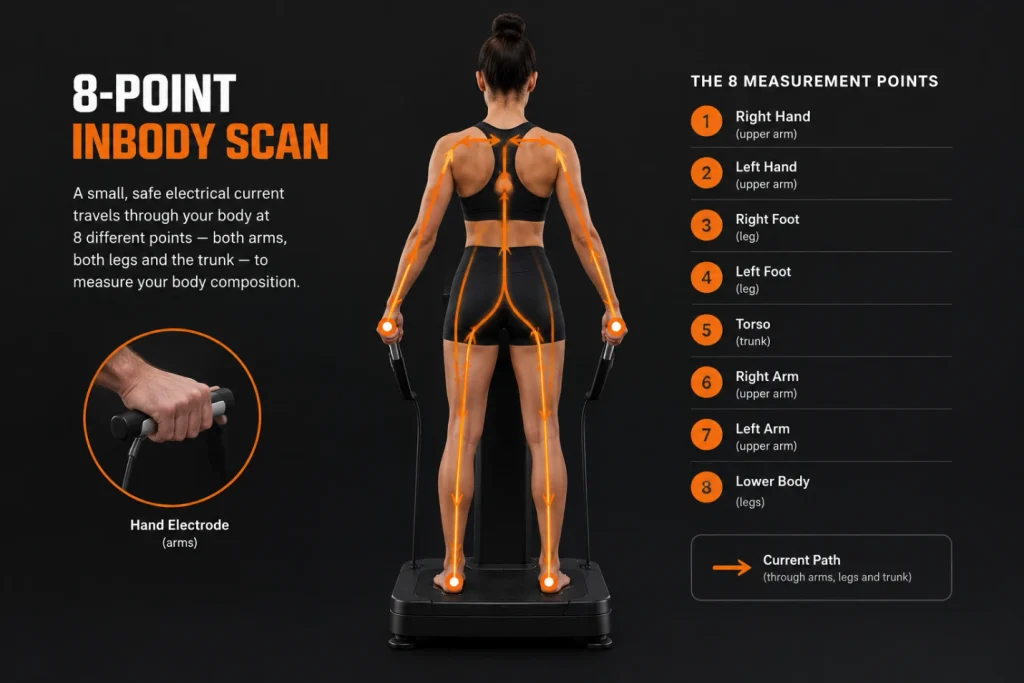
An InBody scan is a body composition test that estimates how much of your weight is muscle, fat and water. It takes about a minute, and you stand on the machine barefoot while holding two handles.
InBody is a brand of body composition analyzer. The machine uses bioelectrical impedance analysis (BIA), which measures how easily a weak electrical current travels through your body.
Water conducts electricity well, and muscle is mostly water. Fat holds very little water, so it resists the current. The InBody turns that resistance into estimates of lean body mass and body fat mass.
Think of it like water flowing through pipes. A wide, clear pipe lets water rush through; a narrow, clogged one slows it down. The machine reads how fast the signal moves and works backward to what the pipes are made of.
Professional models like the InBody 570 and our InBody 580 use eight contact points, at both hands and both feet. That lets them measure each arm, each leg and your trunk separately, instead of guessing from one path through the body.
Is it safe? Yes for most people; the current is too weak to feel. InBody advises against BIA scans during pregnancy as a precaution, and people with a pacemaker or other implanted electronic device should skip it.
InBody results explained: how to read every section
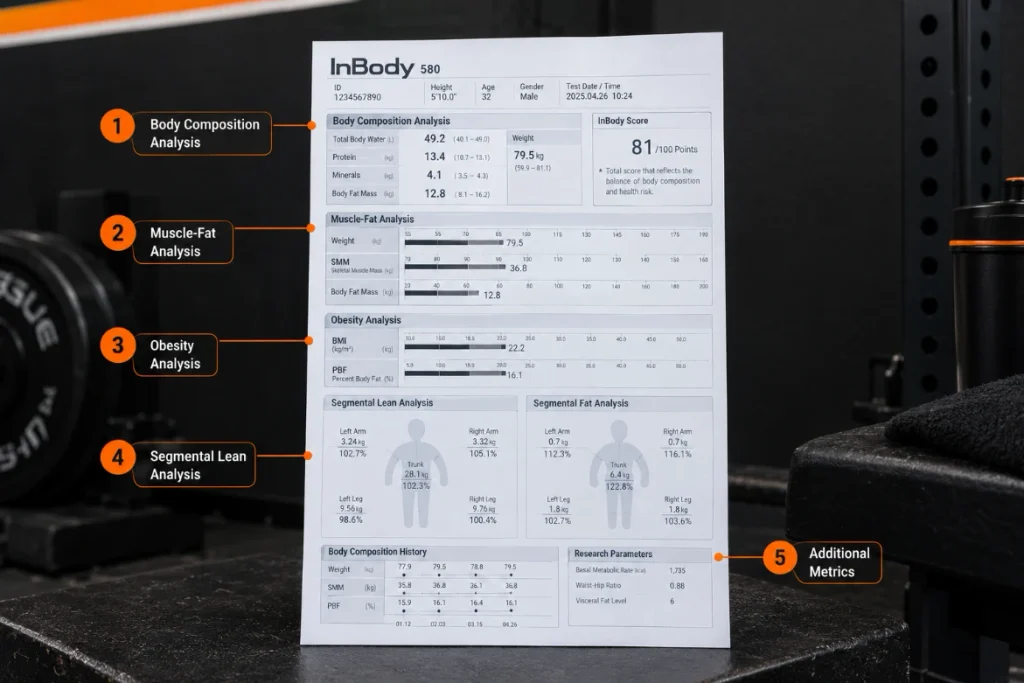
Read your InBody results from top to bottom: what you’re made of, how muscle compares with fat, your obesity markers, then where your muscle sits. Here is what each section on the sheet means.
Body composition analysis: water, protein, minerals and fat
The top box splits your weight into four parts. Added together, they equal your total weight.
- Total body water: the water inside and outside your cells, usually the largest part of your weight.
- Protein: mostly the protein in your muscle. Low protein usually means low muscle.
- Minerals: mainly bone mineral. This is an estimate, not a bone density test.
- Body fat mass: the weight of all the fat in your body.
Protein and minerals together are sometimes called dry lean mass. Add body water and you get lean body mass, which is everything in your body that isn’t fat.
Muscle-fat analysis: the three bars that matter most
This section shows three bars: weight, skeletal muscle mass and body fat mass. Skeletal muscle mass is the muscle you can train, the muscle attached to your bones.
InBody describes three basic shapes you can draw by connecting the ends of those bars:
- C-shape: the muscle bar is shorter than weight and fat. This usually means building muscle should be the first goal.
- Straight shape: all three bars line up, InBody’s balanced type. Your composition is balanced for your size.
- D-shape: the muscle bar sticks out past the other two. This is typical of people who lift.
Obesity analysis: BMI vs percent body fat
This box shows BMI next to percent body fat. InBody itself calls BMI outdated and includes it mainly because research still uses it.
Percent body fat is the number to watch. For context, our guide to what body composition is includes the American Council on Exercise body fat ranges for men and women.
Segmental lean analysis: muscle by arm, leg and trunk
The segmental lean analysis shows how much lean mass you carry in each arm, each leg and your trunk. Each bar compares you with what’s expected for your height and weight.
This is where coaching gets specific. A left leg reading noticeably lower than the right after a knee injury tells us exactly where to focus rehab work.
If you’re coming back from surgery, our guide on what to do after physical therapy ends explains how we use those numbers.
ECW ratio: your body water balance
The ECW ratio compares extracellular water, the fluid outside your cells, with your total body water.
According to InBody’s result sheet guide, most healthy people sit around 0.380, with an acceptable range of 0.360 to 0.390.
A reading above 0.390 can point to swelling or excess fluid, such as after an injury or illness. Small changes between scans are normal.
Visceral fat level
Your visceral fat level estimates the fat packed around your organs. It’s the riskiest type of fat, and InBody links higher levels with diabetes, stroke and dementia.
InBody recommends keeping your visceral fat level under 10, or a visceral fat area under 100 square centimeters. It’s one of the first numbers we check with new clients.
Basal metabolic rate, phase angle and the rest
- Basal metabolic rate (BMR): the calories your body burns at complete rest in a day. More lean body mass means a higher BMR.
- Phase angle: a marker of cell health and the water inside your cells, measured at 50 kHz. Higher is generally better.
- Body composition history: a chart of your past scans. This is the most useful part of the sheet once you’ve tested a few times.
- Weight control: suggested targets for fat to lose or muscle to gain. Treat these as rough guides, not orders.
What is a good InBody score?
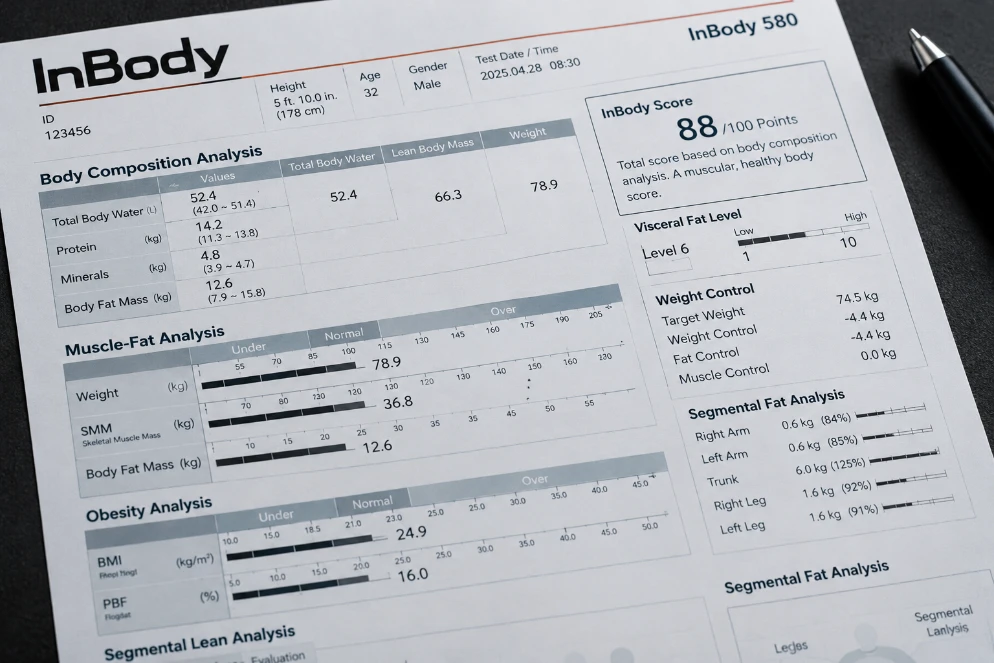
A good InBody score is 80 or higher, which is typical of people who train regularly. The InBody score is a single grade out of 100 that rewards more muscle and less fat for your size.
| InBody score | What it usually means |
| Below 70 | Room to improve muscle, fat or both |
| 70 to 80 | Average to good |
| 80 to 90 | Very good, typical of trained people |
| 90 and above | Excellent, typical of athletes |
Our honest take: don’t chase the score alone. It can climb while a weak leg stays weak, so always look at the segmental lean analysis too.
How accurate is InBody?
InBody is accurate enough to track change over time, but it’s less precise than a DEXA scan for exact numbers. Its biggest weak spot is hydration, since the whole method depends on body water.
The best independent data we found is a 2021 study in the European Journal of Clinical Nutrition. Researchers scanned 226 adults on the InBody 770 and a DEXA scan.
The two agreed closely overall. Still, the InBody read body fat about 3.1 percentage points lower on average, and the gap was largest in people of normal weight.
The authors’ advice matches ours: trust the trend, but read any single InBody body fat number with caution. A 2025 study in the Journal of Strength and Conditioning Research also noted that BIA can be less valid than DEXA for tracking muscle gain.
How to get the most accurate InBody test
Follow these steps before every InBody test:
- Test in the morning, at the same time of day each scan.
- Skip food for 2 to 3 hours before testing.
- Don’t exercise first. A workout shifts fluid into your muscles.
- Use the bathroom right before you step on.
- Keep hydration normal. Don’t chug water or arrive dehydrated.
- Avoid alcohol and saunas the day before.
- Wear similar, light clothing and take off shoes, socks, watches and jewelry.
- Use the same machine every time, because devices don’t always match.
Women may see results move around their menstrual cycle because of water shifts. Testing at the same point in the cycle helps.
InBody vs DEXA: which body fat scan should you use?
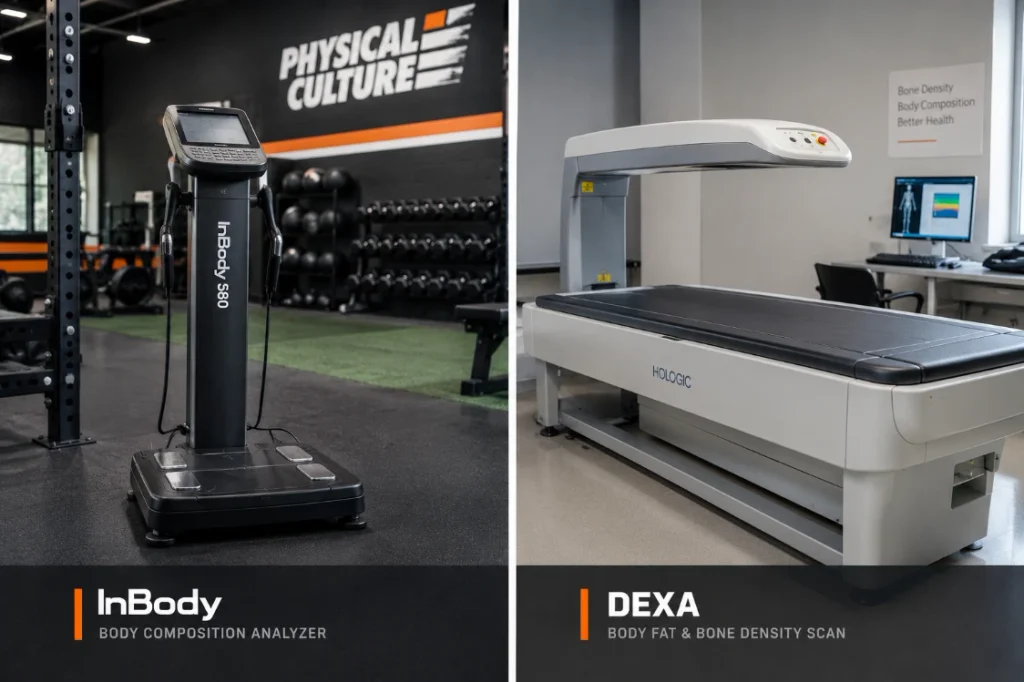
Use a DEXA scan when you need the most precise numbers or bone density, and an InBody scan when you want fast, frequent progress tracking. Many people get the best of both by doing a DEXA scan once a year and an InBody test every few months.
| Factor | InBody (bioelectrical impedance) | DEXA scan |
| How it works | A weak current measures resistance through water and tissue | Low-dose X-ray separates fat, lean tissue and bone |
| Time | About 1 minute | About 10 minutes, plus a clinic visit |
| Where | Gyms, clinics, some doctors’ offices | Hospitals, imaging centers, research labs |
| Bone density | Estimated minerals only | Yes, measured directly |
| Radiation | None | A very small dose |
| Hydration sensitivity | High | Low |
| Best for | Frequent progress tracking | Precise baselines and bone health |
What about other body fat scan options? Hydrostatic weighing, where you’re weighed underwater, was long the research standard. Hydrostatic weighing is accurate but hard to find, and it doesn’t break results down by body part.
Skinfold calipers are cheap but depend heavily on the tester. Home smart scales use the same bioelectrical impedance idea with fewer electrodes, so they’re the least precise.
How to use your InBody results to make progress
Image url: https://drive.google.com/file/d/12xQuT3qn9Rj15OXxRGULtGEviDFwEX0L/view?usp=sharing
Alt text: Coach and client comparing two InBody scans to track progress in skeletal muscle mass and body fat
Use your InBody results by picking one or two numbers to change, then retesting under the same conditions every 8 to 12 weeks. A single scan is a snapshot; three or four scans show direction.
- Set your baseline. The scan in your first fitness assessment is the starting line, not a grade.
- Pick one target. For most people that’s more skeletal muscle mass, less body fat mass or a lower visceral fat level.
- Train for muscle. Strength training is what moves skeletal muscle mass and your InBody score.
- Eat enough protein. Your protein reading can’t climb without it.
- Fix imbalances. Use the segmental lean analysis to target a weaker side.
- Retest every quarter. Progress tracking works only when you compare like with like.
Here’s what this looks like at our gym. Every program starts with a fitness assessment that includes an InBody 580 scan, grip strength and a movement screen. Your lead coach uses those numbers to write your plan, then retests so you can see what changed.
Want to lose fat and build muscle at the same time? Our guide to body recomposition explains how. If you’re on a GLP-1, read how to prevent muscle loss on Ozempic or Wegovy, since the InBody is how we catch it early.
Want your own InBody results read by a coach? Book a free 15-minute consult, or start with our free 5-minute fitness evaluation.
Frequently asked questions
How often should you get an InBody scan?
Every 8 to 12 weeks is enough for most people. Body composition changes slowly, so weekly scans mostly pick up noise from water and food.
We retest our clients at least every quarter, on the same machine and under the same conditions.
Why can InBody body fat go up after losing weight?
Usually because you lose muscle or water along with fat. Fast dieting and low protein strip muscle, which can raise your percent body fat even as the scale drops.
Hydration differences between scans can also cause this. Check your skeletal muscle mass and test conditions before worrying.
Can an InBody scan measure muscle gain accurately?
It can show the trend, but it’s less exact than a DEXA scan for small changes. Water stored in newly trained muscles can make gains look bigger or smaller than they really are.
Look for steady change across three or more scans rather than one jump.
Is an InBody test safe?
Yes, for most people. The current is very weak and you won’t feel it. InBody advises skipping the scan during pregnancy as a precaution, and anyone with a pacemaker or other implanted electronic device shouldn’t use it.
What is the difference between the InBody 570 and InBody 580?
Both are professional, eight-point InBody body composition analyzers that measure each arm, leg and the trunk. The InBody 580 is the newer model, and we use it at our gym.
For you, the key is consistency: compare scans from the same model, since different machines can read slightly differently.
Do you have to fast before an InBody test?
You don’t have to, but it helps. Skipping food for 2 to 3 hours and avoiding exercise beforehand keeps your results comparable from scan to scan.
The bottom line
An InBody scan gives you far more than a body fat number. Skeletal muscle mass, visceral fat level, the ECW ratio and the segmental lean analysis show what your weight is made of and where to focus.
It isn’t as precise as a DEXA scan, so read your results as a trend, not a verdict. If you’re in Brooklyn, visit us at 55 9th Street, Unit 4A, in Gowanus, or book a free consultation to get your InBody results read by a coach.
Last updated: October 27, 2026. This article is for general education and isn’t medical advice. Talk with your doctor about body composition results, especially if you’re pregnant, have an implanted medical device or have a medical condition.