
Last updated: November 2, 2026 | By Brian Velez, Owner, Physical Culture
what you need to know in 30 sec
- Exercise for chronic pain works best when you start below your limit and build slowly, not when you push through pain or rest it out.
- About 24.3% of US adults had chronic pain in 2023, according to the CDC.
- A Cochrane overview of 381 studies found exercise may improve pain severity and physical function, with few side effects beyond short-term soreness.
- Pain science shows long-term pain is often a sensitive nervous system, not ongoing damage, which is why gradual exposure to movement helps.
- Start with low impact exercise and simple strength training, a few minutes a day, and add about 10% a week.
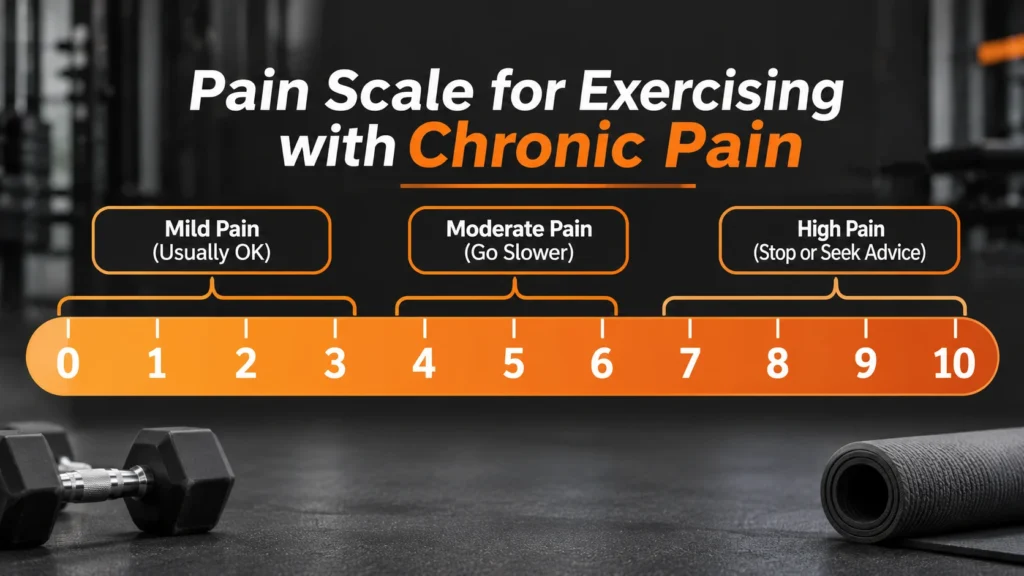
- At our Brooklyn gym, pain around 2 or 3 out of 10 during training is manageable; creeping toward 5 means we back off.

If you live with pain that won’t go away, exercise can feel like the last thing you should do. You’ve probably had a workout that leaves you worse for days, and a doctor tells you to “stay active” without saying how.
Here’s the honest answer: the right exercise for chronic pain usually helps. The wrong dose, too much too soon, is what backfires.
Quick answer: to start exercising with ongoing pain, begin with an amount you can do on a bad day, such as 5 to 10 minutes of walking or gentle strength work. Keep pain during exercise mild, around 2 or 3 out of 10. Then increase by roughly 10% a week, and talk with your doctor or physical therapist before you begin.
Written by Brian Velez, owner of Physical Culture, a private coaching gym in Gowanus, Brooklyn. Our coaching team, including a board-certified physical therapist, works with clients living with back pain, arthritis, nerve pain and chronic conditions through our chronic conditions training program.
Does exercise help chronic pain?
Yes, for most people exercise helps, mainly by improving physical function and, in many studies, reducing pain severity. It isn’t a cure, but it’s one of the few treatments with almost no serious side effects.
Chronic pain is pain that lasts three months or longer, and it’s common.
The CDC reports that 24.3% of US adults had it in 2023, up from 20.4% in 2019.
About 8.5% had high-impact pain that limited daily life.
The best summary of the research is a Cochrane overview of 21 reviews, covering 381 studies and 37,143 people. Here’s what it found:
- Physical function improved in 14 reviews, the most consistent benefit.
- Pain severity improved in several reviews, though results varied by condition and program.
- Side effects were mostly short-term muscle soreness that faded within a few weeks.
We’ll be straight with you: the authors rated the evidence quality as low, mostly because studies were small and short. But “low quality” doesn’t mean “doesn’t work.” It means the benefit is likely real and probably modest, and it depends heavily on how the program is administered.
What does pain science say about exercising with chronic pain?

Pain science shows that chronic pain is often driven by a sensitive nervous system, not by ongoing tissue damage. That’s why moving can feel scary, yet still be safe and helpful.
Central sensitization is when your nervous system stays turned up and amplifies pain signals. StatPearls, the NIH’s clinical reference, describes it as the nervous system remaining “in a state of hyperactivity,” so ordinary touch or light movement can hurt more than it should. It’s linked with fibromyalgia, chronic back pain and osteoarthritis.
Think of it like an overly sensitive smoke alarm. A real fire should set it off. But when the alarm is turned up too high, burnt toast triggers the same blaring noise. The alarm is real; the danger often isn’t.
Pain neuroscience education is the practice of teaching people how pain works, so movement feels less threatening. Understanding that “hurt doesn’t always mean harm” is often the first step toward movement confidence.
Stress, poor sleep quality and inflammation can all turn the alarm up further. Regular, moderate exercise helps calm inflammation over time. Exercise helps on several of those fronts at once, which is part of why it works.
How do you start exercising with chronic pain safely?
Start by finding your baseline, the amount you can do even on a bad day, then build up slowly with pacing and graded activity. Here’s the process we use with clients.
- Talk to your doctor or physical therapist first. Rule out anything that needs medical care, and ask whether any movements are off limits.
- Find your baseline. Pick an activity and do the amount you could manage on a flare day, even if that’s 5 minutes of walking.
- Set the pain rule. Mild discomfort, around 2 or 3 out of 10, is usually fine. If pain climbs toward 5, stop or scale back.
- Use pacing. Pacing means spreading activity through the day and week instead of doing everything on a good day and crashing after.
- Increase about 10% a week. Harvard Health gives the example of walking 10 minutes, then 11 minutes a week later.
- Track how you feel the next day. Pain that settles within 24 hours means the dose was about right.
That last step matters most. A workout that feels fine but leaves you wiped out for two days was too much, even if it felt easy at the moment.
Graded activity vs graded exposure: what’s the difference?
Graded activity builds your overall amount of movement step by step, like adding a minute to your walk each week. Graded exposure targets specific movements you fear, such as bending or lifting, and reintroduces them in small, safe doses.
Both work on the same principle. Your nervous system learns that a movement is safe by doing it successfully, many times, at a level it can tolerate.
What should you do during a pain flare?
During a pain flare, adjust your exercise rather than stopping completely. Drop the load, shorten the session or swap in gentle mobility and walking until the flare settles.
On our chronic conditions page, we put it simply: flare days we adjust, not abandon. Full rest for days tends to make the next restart harder.
What are the best chronic pain exercises?
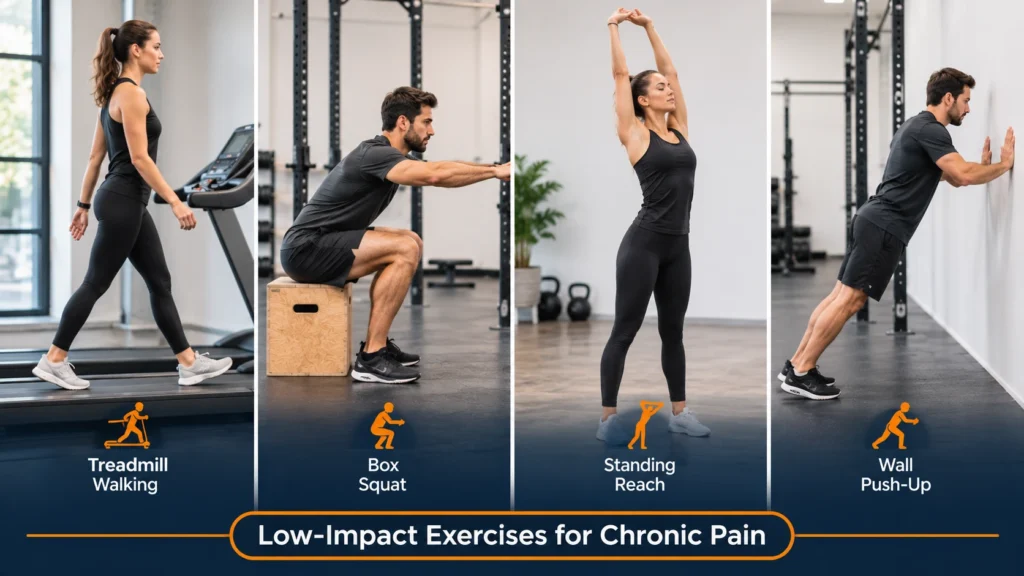
The best exercises are ones you can do consistently: low impact exercise, simple strength training and mobility work. The exact choice matters less than the dose and the consistency.
| Exercise type | Examples | Why it helps | Good starting dose |
| Low impact cardio | Walking, cycling, swimming, water aerobics | Improves circulation, sleep and mood with little joint stress | 5 to 10 minutes, most days |
| Strength training | Box squats, wall push-ups, rows, glute bridges | Builds support around joints and tendons | 1 to 2 sets, 2 days a week |
| Mobility | Cat-cow, hip openers, gentle range of motion drills | Reduces stiffness and keeps joints moving | 5 minutes daily |
| Mind-body | Tai chi, gentle yoga, breathing drills | Calms the nervous system and lowers stress | 10 minutes, a few days a week |
Low impact exercise: the easiest place to start
Low impact exercise is any activity where at least one foot stays in contact with the ground, or where water supports your body. Walking and stationary cycling are the simplest options because you can control the dose to the minute.
For many people with joint pain, water is the friendliest start. The water carries your weight, so joints move with far less load.
Strength training for chronic pain
It means building muscle around the area that hurts, slowly and with control. It’s the part most programs leave out, and the part we prioritize.
Our view is simple: most long-term pain has weakness underneath it. Rest alone rebuilds nothing, so the long-term answer is strength around the joint, the tendon or the limitation.
Start with movements you can do without a pain spike, such as a squat to a box or a push-up against a wall. Then add the load in small steps.
If your pain is in your back, see our guides to lower back pain exercises and training with lower back pain.
Mobility and range of motion work
Mobility work keeps your joints moving through their full range of motion. Even 5 minutes a day reduces the stiffness that makes the first steps of the morning hurt. Our article on mobility vs flexibility explains the difference.
Exercise for fibromyalgia: what’s different?
Exercise for fibromyalgia follows the same rules, but you start lower and build even more slowly. Fibromyalgia is a long-term condition with widespread pain, fatigue and sleep problems, and it’s closely tied to central sensitization.
People with fibromyalgia are especially prone to the boom-and-bust cycle: a good day, too much activity, then several bad days. That’s why pacing matters even more here.
- Start smaller than feels necessary, even 5 minutes.
- Favor low impact exercise such as walking, water exercise or a stationary bike.
- Add strength training gradually, with light loads and long rests.
- Prioritize sleep quality, since poor sleep and pain feed each other.
Harvard Health suggests talking with your doctor about medication timing around exercise, and building activity by about 10% a week.
When should you see a physical therapist instead?
See a physical therapist or doctor before exercising if your pain is new, getting worse, or comes with red flags. A trainer is not the right first stop for an undiagnosed problem.
Get medical care first if you have:
- Numbness, tingling or weakness that is spreading
- Loss of bladder or bowel control
- Unexplained weight loss, fever or night pain
- Pain after a fall or injury
- Chest pain, dizziness or shortness of breath with exercise
A physical therapist diagnoses and treats the problem. A coach builds strength and capacity once you’re cleared. At our gym, we coordinate and share notes with your doctor or physical therapist so both sides move in the same direction.
If you’re finishing physical therapy, our guide to what to do after physical therapy ends covers that handoff.
How does exercise fit into chronic pain management?

Exercise is one part of managing long-term pain, alongside medical care, sleep, stress management and, for many people, pain neuroscience education. It works best when those pieces support each other.
Movement helps in several ways at once. It builds strength, improves sleep quality, lowers stress and gives your nervous system repeated proof that movement is safe. Over months, that adds up to more capacity and more movement confidence.
Erik, a client of ours for five years, started training with us in early 2020 while recovering from chemotherapy. With steady coaching and regular check-ins, he returned to form and now practices Tae Kwon Do better than ever as he approaches 50.
Manav came to us with hip alignment issues and sciatica that had stumped other trainers. His coach worked through it methodically, and he can now deadlift safely and consistently.
Every client’s path is different, and results like these take months, not weeks. But they show what a patient, well-dosed plan can do.
Want help building a plan around your pain? Book a free 15-minute consultation with Brian, or start with our free 5-minute fitness evaluation.
Frequently asked questions
Is it better to rest or exercise with chronic pain?
For most people with persistent pain, gentle exercise beats rest. Long periods of rest lead to weaker muscles and stiffer joints, which tends to make pain worse.
The exception is new or worsening pain, or pain with red flags like numbness or weakness. Get that checked by a doctor first.
Should you exercise through pain?
You can usually exercise with mild pain, around 2 or 3 out of 10, as long as it settles within 24 hours. Sharp pain, pain that climbs past 5, or pain that leaves you worse the next day means the dose was too high.
Scale back, don’t quit.
How long does it take for exercise to help chronic pain?
Most people notice better function and energy within 6 to 12 weeks of consistent exercise. Changes in pain itself often come more slowly. Expect some ups and downs along the way, especially in the first month.
What is the best low impact exercise for chronic pain?
Walking is the easiest place to start because you can adjust it to the minute and do it anywhere. Swimming and water aerobics are great if your joints are very sensitive, since the water supports your weight.
The best option is the one you’ll actually keep doing.
Can strength training make chronic pain worse?
It can if you start too heavy or progress too fast. Done gradually, lifting usually reduces pain over time by building support around sore joints and tendons. Start light, use controlled movements and add load in small steps.
Does exercise help fibromyalgia?
Yes. Exercise is one of the most recommended treatments for fibromyalgia, but it needs a very gradual start. Begin with a few minutes of low impact exercise, add light strength training slowly and use pacing to avoid flares.
The bottom line
Exercise for chronic pain works when the dose is right: start below your limit, keep pain mild, and build slowly. Pain science explains why that patience pays off, since a sensitive nervous system calms down with safe, repeated movement.
You don’t have to figure it out alone. If you’re in Brooklyn, visit us at 55 9th Street, Unit 4A, in Gowanus, call (917) 946-3000, or book a free consultation.