Last updated: November 9, 2026 | By Brian Velez, Owner, Physical Culture
What you need to know about Strength Training for Arthritis
- Strength training for arthritis is safe for most people and one of the most strongly recommended treatments for knee and hip osteoarthritis.
- About 27.9% of US adults, roughly 67.1 million people, have diagnosed arthritis, according to a 2025 CDC study.
- Stronger muscles, especially the quadriceps, take load off sore joints. Weak quads are linked with knee osteoarthritis.
- Start light: two strength days a week, 8 to 12 controlled reps, and add only 10% to 20% at a time, per the Arthritis Foundation.
- On painful days, swap weights for isometrics like wall sits, or for low impact cardio like walking or swimming.
- Avoid locking your joints, jumping and twisting during flares. Most exercises are “not right now,” not “never.”
Most people with achy, stiff joints are told to “take it easy.” Then their muscles weaken, their joints take more of the load, and the pain and joint stiffness get worse.
Strength training for arthritis breaks that cycle. Done right, it’s one of the best things you can do for achy knees, hips and hands.
Quick answer: yes, you can and usually should lift weights with arthritis. Start with light weights or resistance bands twice a week, do 8 to 12 slow reps per exercise, and increase gradually. Keep joint pain mild during training, and talk with your doctor or physical therapist before you begin.
Written by Brian Velez, owner of Physical Culture, a private coaching gym in Gowanus, Brooklyn. Our coaching team, which includes a board-certified physical therapist, trains clients with joint pain, tendinitis and other conditions through our chronic conditions program.
What is arthritis, and should you exercise with it?
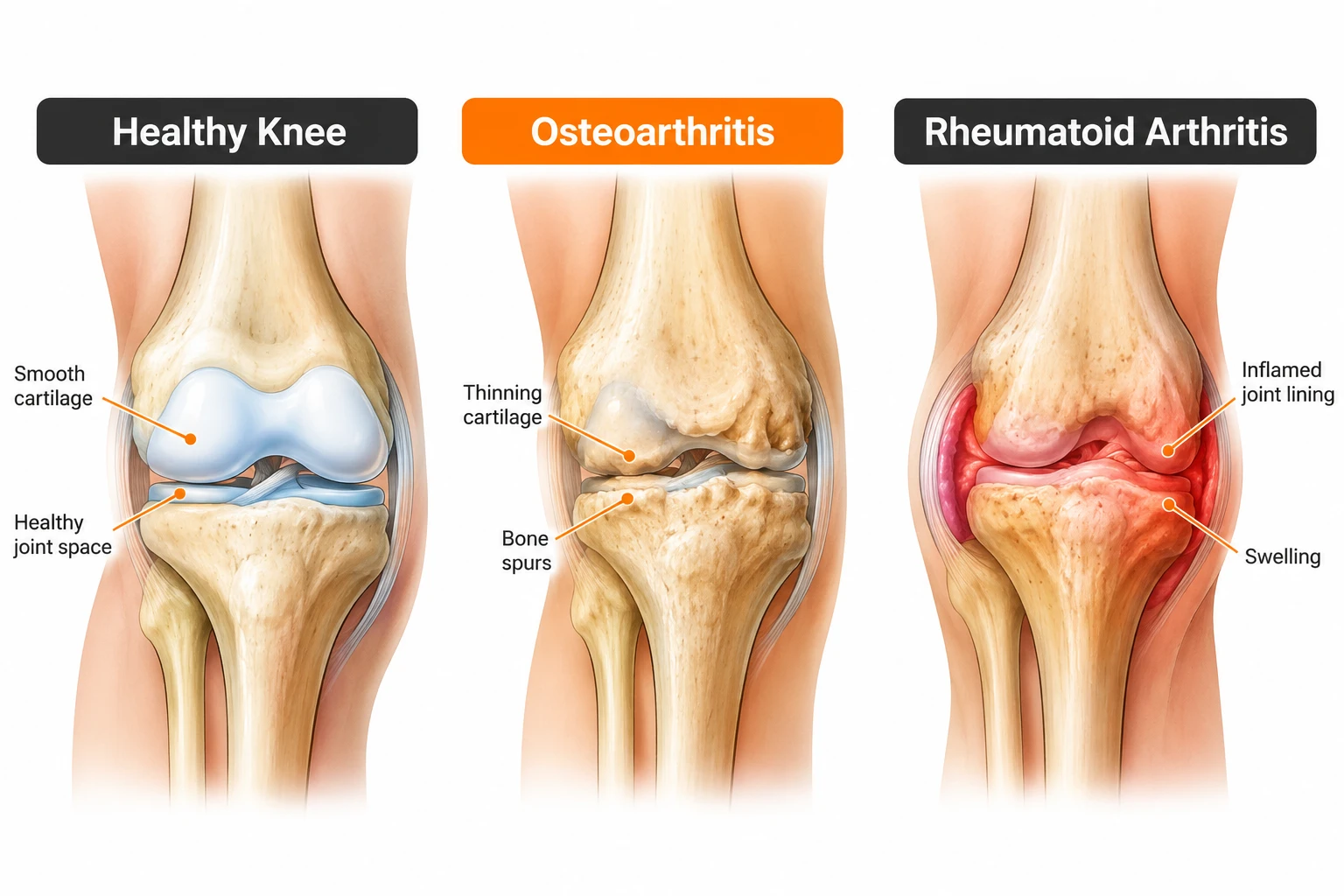
Arthritis is a group of conditions that cause joint pain, swelling and joint stiffness. Yes, you should exercise with it: CDC guidance says physical activity can reduce joint pain and improve function and mood.
It’s also very common. A 2025 CDC study of national health survey data found that 27.9% of US adults aged 20 or older had it.
That’s about 67.1 million people.
The two types you’ll hear about most work very differently:
| Osteoarthritis | Rheumatoid arthritis | |
|---|---|---|
| What it is | Wear and breakdown of cartilage, the smooth tissue that cushions the ends of bones | An autoimmune disease where the immune system attacks the joint lining |
| Main driver | Mechanical load, age, past injury, body weight | Inflammation throughout the body |
| Common joints | Knees, hips, hands, spine | Hands, wrists, feet, often on both sides |
| How exercise helps | Stronger muscles share the load, joints move better | Keeps joints moving, protects muscle and bone, helps fatigue |
Cartilage works like the rubber pads on a car’s suspension. Over time, osteoarthritis thins those pads. You can’t rebuild them with exercise, but you can strengthen the “shocks” around them, which is your muscle.
Why does strength training help arthritis?
Strength training helps arthritis because stronger muscles absorb and spread force that would otherwise go straight through the joint. Less load on the joint usually means less pain and more confidence moving.
The knee shows this most clearly. A study of 462 adults aged 65 and older, published in the Annals of Internal Medicine, found quadriceps strength relative to body weight was about 20% lower in people with knee osteoarthritis.
The authors suggested quadriceps weakness may be a primary risk factor for knee pain, disability and joint damage. That’s why quadriceps strength is the first thing we build with knee clients.
Medical guidelines agree. The 2019 American College of Rheumatology and Arthritis Foundation guideline strongly recommends exercise for hand, hip and knee osteoarthritis. It also notes most programs work better when supervised.
We’ll say it plainly: rest is not a treatment plan. For most people with sore joints, the risk of doing nothing is bigger than the risk of lifting sensibly.
Is weight lifting with arthritis safe?
Yes, weight lifting with arthritis is safe for most people when the load is light, the form is controlled and progress is gradual. The Arthritis Foundation recommends resistance training twice a week.
Here’s how the foundation suggests you set it up:
- Weight: pick one you can lift with perfect form for 8 to 12 reps.
- Progression: increase by about 10% to 20% at a time, or 2 to 5 pounds once a weight feels easy.
- Exercise choice: favor compound moves like squats, rows and presses, and balance front and back muscles.
- Joints: never lock out your knees or elbows at the top of a rep.
- Grip: if your hands hurt, use resistance bands instead of dumbbells.
Use isometrics on painful days
Isometrics are exercises where your muscle works but your joint doesn’t move, like a wall sit or a plank. Think of pushing against a wall that won’t budge: your muscles fire hard, yet nothing grinds.
That’s why the Arthritis Foundation suggests isometrics when joints are sore. A 20 to 30 second wall sit builds quadriceps strength with very little joint movement.
What pain is acceptable during exercise?
Mild discomfort is usually fine; sharp or rising pain is not. Good pain management in training is about dosing, not avoiding movement. Our working rule at the gym is simple: pain around 2 or 3 out of 10 is manageable, and creeping toward 5 means we back off.
Mild muscle soreness a day or two later is normal. Joint pain that keeps building over several sessions is a sign to scale back and check in with your doctor or physical therapist.
What are the best exercises for arthritis?
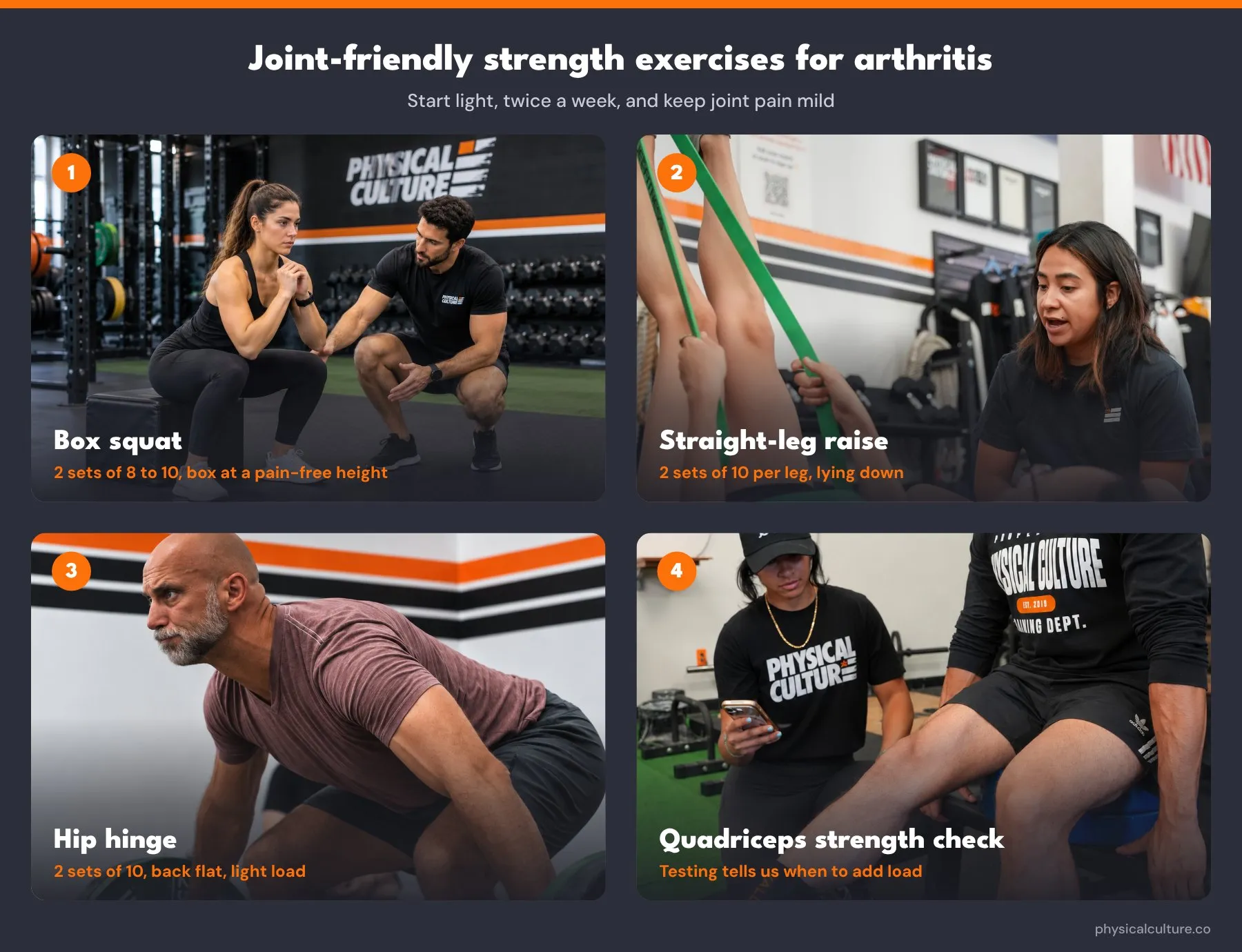
The best exercises for arthritis are simple, controlled strength moves for your legs, hips, back and upper body, done with a range of motion that feels comfortable. You can scale every one of them up or down.
| Exercise | Main muscles | Why it helps | Easier version |
|---|---|---|---|
| Box squat | Quadriceps, glutes | Builds leg strength with a set depth | Sit-to-stand from a high chair |
| Wall sit | Quadriceps | Isometric, so the knee stays still | Higher position, shorter hold |
| Step-up | Quadriceps, glutes | Trains stairs and single-leg control | Lower step, hold a rail |
| Glute bridge | Glutes, hamstrings | Supports hips and lower back | Smaller lift, both feet wide |
| Banded row | Upper back | Posture and shoulder support | Lighter band |
| Farmers carry | Grip, core, legs | Real-life strength for bags and groceries | Lighter weights, shorter walk |
A box squat is a squat where you sit back to a box or bench, then stand up. The box sets your depth, so you don’t drop lower than your knees tolerate.
Knee arthritis exercises
Knee arthritis exercises should focus on quadriceps strength, since strong quads protect the knee joint. These are the osteoarthritis exercises we usually start with for knee osteoarthritis:
- Sit-to-stand or box squat: 2 sets of 8 to 10, using a box high enough to stay pain-free.
- Wall sit: 3 holds of 20 to 30 seconds, at a comfortable angle.
- Step-up: 2 sets of 8 per leg, on a 4 to 6 inch step.
- Straight-leg raise: 2 sets of 10 per leg, lying down.
Lower the box and raise the step height slowly as your knees settle.
Hip arthritis exercises
Hip arthritis exercises should build the glutes and keep the hip moving through its range of motion. For hip osteoarthritis, these are a good start:
- Glute bridge: 2 sets of 10, squeezing at the top.
- Banded side steps: 2 sets of 10 steps each way.
- Hip hinge with a dowel: 2 sets of 10, keeping your back flat.
- Gentle mobility: hip circles and supported lunges for 5 minutes.
Stiff hips often loosen up with movement. If you feel better after 10 minutes of activity, that’s a good sign the exercise suits you.
Good mobility matters as much as strength here. Our guide to mobility vs flexibility explains the difference.
What exercises should you avoid with knee arthritis?
The exercises to avoid knee arthritis are the ones that load a sore knee at a bad angle or with sudden impact. Most of them are “not right now,” not “never,” and can return as you get stronger.
- Deep loaded squats and lunges past the depth your knee tolerates. Use a box to cap the depth instead.
- Jumping and high-impact running during a flare. The Arthritis Foundation advises avoiding them when pain is up.
- Twisting and pivoting sports moves, like quick direction changes on a planted foot.
- Locking out your knees at the top of squats or leg presses.
- Leg extension machines with heavy loads, which can stress the kneecap. Light loads and a short range are usually fine.
The test is simple. If an exercise raises your pain past a 5 out of 10, or leaves your knee swollen the next day, swap it for an easier version.
Is walking good for arthritis?
Yes. Walking is low impact cardio that keeps joints moving, helps manage weight and is on the CDC’s list of joint-friendly activities.
The CDC recommends adults with joint conditions aim for 150 minutes of moderate activity a week, plus at least 2 days of muscle strengthening. You can split those minutes into 5 or 10 minute walks.
Here’s our honest take: walking is great, but it isn’t enough on its own. It does little to build the quadriceps strength your knees need, so pair it with two strength sessions a week.
If walking hurts, cycling, swimming and water exercise put even less load on your joints.
Exercise for rheumatoid arthritis: what’s different?
Exercise for rheumatoid arthritis follows the same principles, but you plan around inflammation and flares. Rheumatoid arthritis is an autoimmune disease, so how your joints feel can change from week to week.
- Train around flares. On high-inflammation days, switch to a gentle range of motion work and isometrics.
- Expect morning joint stiffness. Many people do better training later in the day.
- Protect small joints. Use bands, straps or machines if gripping a dumbbell hurts your hands.
- Work with your rheumatologist. Medications and disease activity affect what’s right for you.
Strength still matters. RA tends to cost muscle over time, and stronger muscles help protect your joints and keep daily tasks manageable.
How do you start strength training with arthritis?

Start by getting cleared, finding your baseline, and building slowly over 8 to 12 weeks. Here is the process we use.
- Talk to your doctor or physical therapist. Ask whether any movements or joints are off limits.
- Warm up for 5 minutes. Walk or do a gentle range of motion moves; skip stretching cold muscles.
- Pick 4 to 6 exercises. Use the table above and start with the easiest versions.
- Do 1 to 2 sets of 8 to 12 reps, twice a week, on non-consecutive days.
- Add 10% to 20% at a time. Change one thing per week: weight, reps or sets.
- Track your joints the next day. Swelling or pain that lasts means you did too much.
Here’s a simple starting week:
| Day | What to do |
|---|---|
| Monday | Strength session, 30 minutes |
| Tuesday | 20 minute walk or bike ride |
| Wednesday | Mobility, 10 minutes |
| Thursday | Strength session, 30 minutes |
| Friday | 20 minute walk or swim |
| Weekend | One easy walk and rest |
Weight loss also helps hip and knee osteoarthritis, and the ACR guideline strongly recommends it when appropriate. Our guide to body recomposition explains how to lose fat while building muscle.
Want a coach to build this around your joints? Book a free 15-minute consult, or start with our free 5-minute fitness evaluation.
When should you see a physical therapist for arthritis?
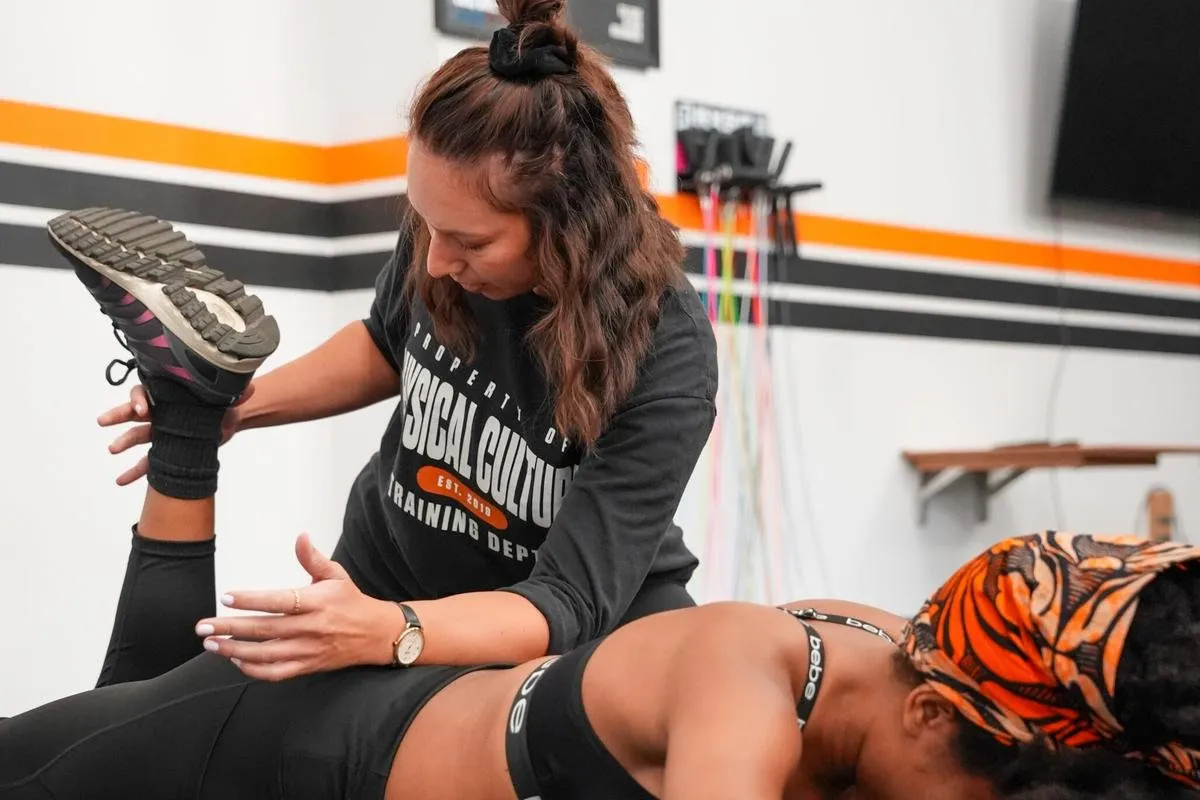
See a physical therapist if your joint pain is new, getting worse, or stops you from doing daily tasks. Physical therapy diagnoses the problem and handles early pain management; a coach builds strength once you’re cleared.
Get medical care first if a joint is hot, red and swollen, if you can’t bear weight, or if you have a fever with joint pain.
Strength training also matters around joint replacement. Building strength before surgery, often called prehab, can make recovery easier.
After a joint replacement, training beyond rehab helps you get back to full strength.
If you’ve just finished physical therapy, our guide on what to do after physical therapy ends covers the handoff. For other kinds of long-term pain, see our guide to exercise for chronic pain.
Frequently asked questions
Can strength training reverse arthritis?
No. Strength training can’t regrow cartilage or reverse joint damage. What it can do is reduce pain, improve how well your joints work and make daily tasks easier.
For many people, that difference is huge, even though the X-ray looks the same.
How often should you strength train with arthritis?
Twice a week is the standard recommendation from both the CDC and the foundation. Leave at least a day between sessions so your joints can recover.
On other days, add low impact cardio like walking, cycling or swimming.
Is it OK to exercise during an arthritis flare?
Usually, yes, but gently. During a flare, skip heavy weights and switch to isometrics, gentle range of motion work or a short walk. Complete rest for days often makes stiffness worse.
If a joint is hot, very swollen or the pain is severe, contact your doctor.
Are squats bad for knee arthritis?
No, squats are often one of the best knee arthritis exercises. The key is depth and load. Squat to a box or chair at a height that doesn’t hurt, use light weight, and lower the box slowly over weeks.
What is the best low impact cardio for arthritis?
Walking, cycling and swimming are the most common choices. Water exercise is especially joint friendly because the water supports your body weight. Pick the one you enjoy, since consistency matters more than the activity.
Are you too old to start lifting weights with arthritis?
No. People in their 70s and 80s build strength with resistance training. Start with light weights or bands, focus on form and progress slowly. A coach or physical therapist can help you start safely.
The bottom line
Strength training for arthritis works because stronger muscles protect sore joints. Start light, train twice a week, use isometrics on bad days and build slowly.
If you’re in Brooklyn and want help, visit us at 55 9th Street, Unit 4A, in Gowanus, call (917) 946-3000, or book a free consultation.
Last updated: November 9, 2026. This article is for general education and isn’t medical advice. Talk with your doctor, rheumatologist or physical therapist before starting a new exercise program.